Three airports, not one “London”
Avi-Go’s 2025 annual report put London’s three top business aviation airports — Farnborough, Luton and Biggin Hill — at a combined 69,988 movements for the year. Farnborough alone logged 26,535 movements in 2025, up 2.05% year on year. That is not a single gateway; it is a cluster that, together, rivals Europe’s busiest dedicated business fields.
The January–August 2025 window makes the ranking clearer. Farnborough ranked fourth among European business aviation airports, with 17,579 movements; Luton fifth, with 17,488; Biggin Hill eighth, with 12,211. The triad combined for 47,288 movements and 5,078 active aircraft in those eight months, and connected to 587 cities from Luton, 558 from Farnborough and 444 from Biggin Hill — more than 800 unique cities across the three.
Summer 2026 kept the same pattern. In June alone, Avi-Go recorded 1,542 arrivals into Farnborough and 1,198 into Luton among Europe’s top inbound flows — 2,740 between them. London–Paris remains the continent’s busiest business aviation city pair; see Europe’s busiest private jet routes. The point for a client is simpler: you are choosing among three working airports, each with its own rules.
Farnborough — the dedicated business gateway
Farnborough (EGLF) is the UK’s purpose-built business aviation airport west of London. It is the field I default to when the brief is premium handling, a drive-to-aircraft arrival, and an operator that already bases or positions there. The airport’s published opening times are Monday to Friday 07:00–22:00, and Saturday, Sunday and bank holidays 08:00–20:00; Christmas Day and Boxing Day are closed. Extensions are not part of the published regime.
Movements are arranged by prior permission and handling, not by ACL runway slots of the kind Luton requires. That is an operational advantage on a quiet weekday and a constraint when the apron and the evening curfew fill on a peak Friday. OPSGROUP’s 2026 London night-ops note puts the same weekday and weekend hours and adds that extensions are not possible. Late arrivals that would work at Luton in winter often will not work at Farnborough at all.
I favour Farnborough when the client is coming from or going to western or south-western Europe, when the aircraft is large-cabin, or when the ground transfer to west London, Surrey or the M4 corridor is shorter than the slog from the north. It is not my first choice for a 23:30 arrival, or for a Sunday evening that must clear after 20:00.
Luton — slots, 24-hour structure, summer nights
Luton (EGGW) sits north of London and is the field that looks most like a major airport with a business aviation overlay. London Luton Airport’s Charges and Conditions of Use, effective 1 January 2026, state that it is an IATA Level 3 slot-coordinated airport: no fixed-wing flight may operate without a runway slot allocated by Airport Coordination Limited (ACL). Handling must be pre-appointed. That paperwork is the price of access to a field that, structurally, can run around the clock.
Summer changes the night picture. OPSGROUP’s April 2026 briefing on London night operations reported that from 1 June to 30 September 2026, only a very limited number of business aviation night movements would be allowed between 23:00 and 06:59, for quieter aircraft (QC 0.5 or less), with Signature allocated six night movements a month and Harrods Aviation four. Outside that summer window, Luton remains the London option I price when the itinerary genuinely needs a late arrival or an early departure that Farnborough and Biggin Hill cannot publish.
I favour Luton for north-London and Midlands connections, for aircraft already positioned on airline-adjacent FBOs, and whenever the clock is the constraint. I do not treat a summer night slot as available until the handler confirms it.
Biggin Hill — south-east London, no runway slots
Biggin Hill (EGKB) is the south-east answer. The airport states that it is just 12 miles from Canary Wharf and 15 miles from central London, with no runway slots required. Its published operating hours are Monday to Friday 06:30–23:00 local, and Saturday, Sunday and bank holidays 08:00–22:00. The main runway is 1,806 m, which covers most light, midsize and many large-cabin charters; very large types need a performance check.
Avi-Go put Biggin Hill eighth in Europe for January–August 2025, with 12,211 movements and links to 444 cities. It is quieter than Farnborough or Luton in absolute volume, and often the cleanest door-to-door choice for the City, Canary Wharf, Kent and the south-east. OPSGROUP notes it as a dedicated business aviation airport with no slots required and weekday hours that run later than Farnborough’s.
I favour Biggin Hill when the ground transfer to east or south-east London dominates the brief, when the aircraft is light or midsize, or when we want to avoid ACL slot risk at Luton. I still confirm operating hours on bank holidays, and I still price a fallback if the arrival sits near the evening close.
How I choose — and what the charter costs
The decision tree I use is short. Where is the meeting or the residence? What time must the wheels stop? Which side of London avoids the worst traffic at that hour? Only then do I look at the aircraft already in position. Peak weeks — Formula 1, Wimbledon, Christmas — tighten every apron; see managing peak-event charter demand.
The flight itself is often the familiar part of the bill. Jet Supply’s European Private Jet Charter Price Index, Q3 2026 puts London to Paris on a light jet from €8,300 all-in (52 minutes block, billed at the 1.5-hour minimum), and London to Geneva from €8,300 on a light jet. Light jets sit at €4,700–€7,500 per block hour in that index. Those are indicative from-prices; the London airport choice adds handling, parking and, at Luton, the slot and any night charges — not a different cabin class.
Repositioning still moves the invoice. An aircraft finishing at Farnborough may quote differently into Biggin Hill than one already at Luton. That is repositioning economics, and it is why I ask the operator where the aircraft wakes up before I defend a particular London field.
- West London, Surrey, M4 corridor → Farnborough first.
- North London, early/late clock, winter night → Luton, subject to ACL slot.
- City, Canary Wharf, Kent, south-east → Biggin Hill first.
- Summer night (1 June–30 September) → do not assume Luton night capacity; confirm via the FBO.
- Always price a second London airport when the arrival sits within an hour of a published close.
My view, briefly
“London” is three airports with three rulebooks. Farnborough is the dedicated business gateway with a firm evening close. Luton buys clock flexibility at the price of ACL slots and a tight summer night pool. Biggin Hill buys geography for the south-east without a runway slot. I pick the airport for the ground journey and the clock first; the aircraft follows. Charter enquiries I take are fulfilled through Limitless Sky — and the first line on the brief is still which London.
Frequently asked questions
Which London airport is best for a private jet? — It depends on where you are going in the city and what time you land. Farnborough suits west London and premium dedicated business aviation; Biggin Hill suits the City, Canary Wharf and the south-east; Luton suits early or late movements when a slot is available.
Do I need a slot for a private jet to London? — At Luton, yes: it is an IATA Level 3 airport and every fixed-wing flight needs an ACL runway slot. Biggin Hill states that no runway slots are required. Farnborough operates on prior permission and handling rather than ACL runway slots.
Can a private jet land at Heathrow? — Rarely for pure private itineraries. Heathrow prioritises scheduled traffic; business aviation access is limited. Farnborough, Luton and Biggin Hill are the practical London gateways.
What are Farnborough’s opening hours? — The airport publishes Monday–Friday 07:00–22:00 and weekends and bank holidays 08:00–20:00, closed on Christmas Day and Boxing Day. Extensions are not part of the published regime.
Is Luton open all night for private jets? — Structurally it is a 24-hour, slot-coordinated airport, but summer 2026 night business aviation movements (23:00–06:59, 1 June–30 September) were reported as very limited and QC-restricted. Confirm any night movement with the appointed FBO before you rely on it.
Planning a specific journey? Live charter enquiries are handled by Limitless Sky, where the operator, aircraft and terms for your itinerary can be discussed.
Sources & editorial notes
Written by Dr. Christoph Lymbersky as an authored perspective drawing on the public sources below. Sources reviewed 15 October 2026. General editorial guidance, not an individual operating, legal, tax or investment recommendation. Scenarios are labelled illustrative and do not describe real clients. No market-wide prices, statistics or guaranteed aircraft performance are asserted.
- Avi-Go — 2025 Annual Business Aviation Report (RD200) ↗
Flight-tracking research on business jet departures, countries, airports and aircraft in 2025.
- Avi-Go — Research & Consulting ↗
Avi-Go periodic market research, including January–August 2025 and 2026 monthly European data.
- Jet Supply — European Private Jet Charter Price Index Q3 2026 ↗
Brokerage all-in European block-hour bands from quoting data on 66 priced aircraft; indicative from-prices, not a live quote.
- Farnborough Airport — Contact / opening times ↗
Airport-published opening times for passengers and flight enquiries; Christmas Day and Boxing Day closed.
- London Biggin Hill Airport — Operations ↗
Airport operations overview: distance to Canary Wharf and central London, and statement that no runway slots are required.
- London Biggin Hill Airport — Noise & airspace / operating hours ↗
Airport-published operating hours for take-off and landing on weekdays, weekends and bank holidays.
- London Biggin Hill Airport — Airfield specification ↗
Airport-published runway length, opening times and airfield data. Not for operational use; the AIP governs.
- London Luton Airport — Charges and Conditions of Use (effective 1 January 2026) ↗
Airport conditions stating IATA Level 3 slot coordination via ACL for all fixed-wing flights, and ground-handling requirements.
- OPSGROUP — London Night Ops: What’s Changing This Summer (April 2026) ↗
Industry operations briefing on summer 2026 night rules at London business aviation airports, including Luton night-movement limits and Farnborough/Biggin Hill hours.
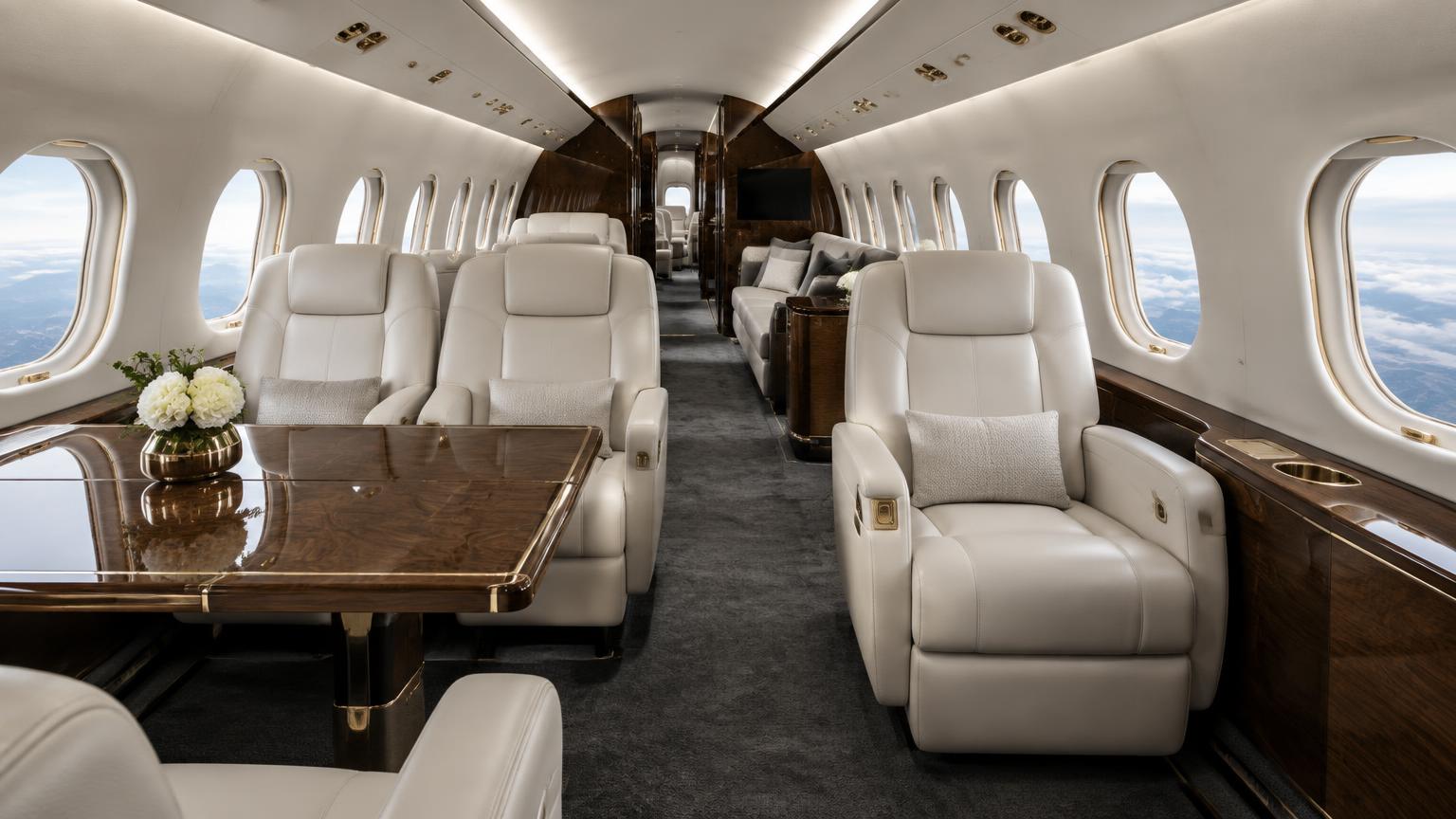
The illustrations are generated aviation imagery, not evidence of a specific aircraft or operator.
For a live itinerary, see the charter advisory guide or start a private enquiry.