The operator carries the liability, not the broker
A charter flight is operated by an airline in the legal sense: a company with an air operator certificate, its own crews and its own insurance. The UK Civil Aviation Authority puts it plainly: a paid flight in a business jet is commercial air transport, and the operator must have the correct certificate, insurance and licences. The company that sells you the flight may be a different one, which is why EU law requires that passengers are told the identity of the operating air carrier at the time of reservation (Article 11 of Regulation 2111/2005).
That distinction decides who answers for an accident. The Montreal Convention distinguishes between a “contracting carrier”, which as a principal makes the contract of carriage, and an “actual carrier”, which performs it (Articles 39 and 40). Both are subject to the Convention, the first for the whole journey, the second for the part it flies. A broker who acts as the client’s agent, as I do, is neither; I explain the roles in what a charter broker actually does. A seller who contracts as principal can be a contracting carrier, and that is worth knowing before you sign.
What the Montreal Convention guarantees a passenger
On an international charter, the passenger’s rights against the carrier come from the Montreal Convention of 1999. The carrier is liable for death or bodily injury caused by an accident on board or during embarkation and disembarkation (Article 17), in two tiers. Up to a threshold, it cannot exclude or limit its liability; above it, it escapes liability only if it proves the damage was not due to its negligence, or was caused solely by a third party (Article 21).
The thresholds are revised for inflation every five years. Since 28 December 2024 they stand at 151,880 Special Drawing Rights per passenger for death or injury, 6,303 for delay and 1,519 for baggage. ICAO put those figures at about US$202,500, US$8,400 and US$2,000 when it announced them in October 2024. Within the European Union, Regulation 889/2002 applies the Convention’s rules to EU carriers on domestic flights within a single Member State as well, and requires an advance payment for immediate needs within 15 days of identifying the person entitled to compensation, of not less than 16,000 SDRs per passenger in the event of death.
Two procedural points are easy to miss. Damage to checked baggage must be notified in writing within seven days of receipt, and delay within 21 days (Article 31), and any claim is extinguished if no action is brought within two years (Article 35). A passenger carrying something unusually valuable can make a special declaration of interest when the baggage is handed over (Article 22); otherwise the baggage limit applies.
What insurance European law requires
Liability is only as good as the money behind it. Regulation 785/2004 sets minimum insurance for every air carrier and aircraft operator flying within, into, out of or over the EU. For passengers, the minimum is 250,000 SDRs per passenger, comfortably above the Montreal threshold; by my arithmetic, at the rate ICAO used in 2024, that is about US$333,000. The insured risks must include acts of war, terrorism, hijacking, sabotage, unlawful seizure of aircraft and civil commotion, and cover must exist for each and every flight, whether the aircraft is owned or leased.
Cover for third parties on the ground rises with the aircraft’s maximum take-off mass, in ten categories from 750,000 SDRs below 500 kg to 700 million SDRs for the largest airliners. Applied to aircraft I quote often: a Citation XLS Gen2, at 9,299 kg, falls in the category below 12 tonnes, with a minimum of 18 million SDRs; a Citation Longitude, at 17,917 kg, in the category below 25 tonnes, at 80 million; a G650ER, at 103,600 lb, roughly 47 tonnes by my conversion, in the category below 50 tonnes, at 150 million. The same rules apply to a privately owned aircraft flown for its owner, although Member States may set a lower passenger minimum of 100,000 SDRs for non-commercial flights in aircraft of 2,700 kg or less.
The American minimums are lower than many assume
In the United States the floor is set by the Department of Transportation, and for on-demand air taxi operators it is modest. A Part 298 air taxi operator carrying passengers must hold passenger liability cover of at least $75,000 per passenger, with a total per aircraft of $75,000 times 75 percent of the passenger seats installed, plus third-party cover of $75,000 per person, $300,000 per aircraft and $100,000 for property (14 CFR 205.5). Larger direct air carriers must carry $300,000 per passenger. A minimum is not a measure of what any particular operator carries; it is only the point below which it may not go.
US rules also speak to brokers directly. Before contracting, an air charter broker must disclose the operator in operational control, the capacity in which the broker is acting, and the existence or absence of any liability insurance the broker holds covering the charterer and passengers, with its limits (14 CFR 295.24). Telling clients they are directly insured when the only cover protects the carrier or the broker is listed as an unfair or deceptive practice (14 CFR 295.50). I find that a useful standard on both sides of the Atlantic.
What I ask for before I confirm an aircraft
I do not rely on a sentence in a quote saying the aircraft is “fully insured”. I ask for documents, and I compare them with each other. The checks overlap with the ones I describe in how to judge a broker’s credibility and in what safety ratings do and do not tell you.
- The operator’s certificate of insurance, naming the operator and the aircraft registration that will fly the trip.
- Passenger liability limits per passenger or per occurrence, and the policy’s validity dates against the dates of the trip.
- War and allied perils cover, particularly for routings near conflict areas.
- The operator named on the insurance certificate is the same one named on the AOC and in the contract.
- If anyone in the chain contracts as principal, who that is, and what cover it holds.
- For the client: whether their own life, accident or travel policy covers travel on a non-scheduled private aircraft. I ask clients to check the wording; I do not assume.
What insurance does not do
Liability insurance pays for injury, death, lost baggage and damage to others. It does not refund a cancelled trip, compensate a missed meeting or settle a dispute over a substituted aircraft; those turn on the charter agreement, which I discuss in the costs of disruption and how contracts allocate them. Nor does a clean insurance certificate prove that the flight is legal: a policy written for private use may not respond to a flight that was in fact sold for hire.
A hypothetical example shows where the limits sit. A family flies from London to Nice and a suitcase with a dinner jacket and a watch arrives damaged. Under the Convention, the operator’s liability for that bag is capped at 1,519 SDRs per passenger unless a special declaration was made, and the claim must be in writing within seven days. The watch belongs in the cabin, or on a separate valuables policy; the insurance on the aircraft was never designed for it.
Questions I am asked
Is my broker liable if something happens on a charter flight? — Normally the operator, as the carrier, is liable to passengers under the Montreal Convention. A broker acting as your agent is not the carrier. A seller who contracts as principal can be treated as a contracting carrier, liable for the whole journey alongside the operator.
How much compensation does the Montreal Convention guarantee? — Since 28 December 2024, up to 151,880 SDRs per passenger for death or injury cannot be excluded or limited; above that, the carrier is liable unless it proves it was not negligent. Delay is capped at 6,303 SDRs and baggage at 1,519 SDRs.
What insurance must a charter operator carry in Europe? — Under Regulation 785/2004, at least 250,000 SDRs per passenger, including war and terrorism risks, plus third-party cover by maximum take-off mass: 18 million SDRs for a jet below 12 tonnes, 80 million below 25 tonnes.
What insurance must a US charter operator carry? — A Part 298 air taxi operator must carry at least $75,000 per passenger, with an aircraft total of $75,000 times 75% of the seats, plus third-party cover. These are minimums; ask for the actual certificate.
Do I need my own travel insurance on a private jet? — The operator’s liability cover does not refund cancellations or protect valuables beyond the baggage limit. Whether your own policy covers non-scheduled private aircraft depends on its wording; check it before you fly.
Planning a specific journey? Live charter enquiries are handled by Limitless Sky, where the operator, aircraft and terms for your itinerary can be discussed.
Sources & editorial notes
Written by Dr. Christoph Lymbersky as an authored perspective drawing on the public sources below. Sources reviewed 23 November 2026.
General guidance, not individual legal, tax or investment advice. Figures come from the sources below unless marked as my own calculation. Client examples are anonymized.
- Convention for the Unification of Certain Rules for International Carriage by Air, Montreal, 28 May 1999 — full text (IATA) ↗
Article 17 carrier liability for death or injury from an accident on board or during embarkation/disembarkation; Article 21 two-tier liability; Article 22 baggage limit and special declaration of interest; Article 31 written complaint within 7 days (baggage damage) or 21 days (delay); Article 35 two-year limitation; Articles 39–41 contracting and actual carrier. Text shows original limits; see ICAO 2024 revised limits.
- ICAO — 2024 Revised Limits of Liability under the Montreal Convention 1999 ↗
Effective 28 December 2024: Article 21 151,880 SDRs (from 128,821); Article 22(1) delay 6,303 SDRs; Article 22(2) baggage 1,519 SDRs; Article 22(3) cargo 26 SDRs per kg.
- ICAO — International air travel liability limits set to increase (18 October 2024) ↗
Limits rise on 28 December 2024 under the five-yearly inflation review: death or injury 151,880 SDRs (about US$202,500); delay 6,303 SDRs (about US$8,400); baggage 1,519 SDRs (about US$2,000); 140 States Parties.
- Regulation (EC) No 889/2002 amending Regulation (EC) No 2027/97 on air carrier liability in the event of accidents (EUR-Lex) ↗
Applies the Montreal Convention to EU air carriers, including carriage within a single Member State (Articles 1 and 3); advance payment within 15 days of identifying the person entitled to compensation, not less than 16,000 SDRs per passenger in the event of death (Article 5).
- Regulation (EC) No 785/2004 on insurance requirements for air carriers and aircraft operators, consolidated version of 30 July 2020 (EUR-Lex) ↗
Applies to air carriers and aircraft operators flying within, into, out of or over the EU; insured risks include war, terrorism, hijacking, sabotage, unlawful seizure and civil commotion; cover for each and every flight (Article 4); insurance certificate deposited with the competent authority (Article 5); passengers 250,000 SDRs, or at least 100,000 SDRs for non-commercial operations of aircraft of 2,700 kg MTOM or less (Article 6); third-party minimums by MTOM, e.g. 18 million SDRs below 12,000 kg, 80 million below 25,000 kg, 150 million below 50,000 kg (Article 7).
- European Commission, Mobility and Transport — Air: insurance requirements ↗
Third-party minimum cover per accident and aircraft depends on MTOM: 750,000 SDR below 500 kg; 80 million SDR for 12–25 tonnes; 500 million SDR for 200–500 tonnes.
- US Code of Federal Regulations — 14 CFR 205.5, Minimum coverage (eCFR) ↗
Direct air carriers: passenger liability $300,000 per passenger. US air taxi operators registered under Part 298: passenger liability $75,000 per passenger, aircraft total $75,000 × 75% of passenger seats; third-party $75,000 per person, $300,000 per aircraft per occurrence, and $100,000 property damage.
- US Code of Federal Regulations — 14 CFR Part 295, Air Charter Brokers (eCFR) ↗
§295.24: before contracting, brokers must disclose the operator in operational control, the capacity in which they act, and the existence or absence of broker-held liability insurance covering the charterer and passengers, with its limits; §295.50 lists misrepresenting that passengers are directly insured, when the only cover protects the carrier or broker, as an unfair or deceptive practice.
- Regulation (EC) No 2111/2005 — EU Air Safety List and identity of the operating air carrier (Article 11) ↗
Article 11(1): upon reservation, the air carriage contractor shall inform the passenger of the identity of the operating air carrier or carriers, whatever the means used to make the reservation.
- UK Civil Aviation Authority — Charters and air taxi flights ↗
A paid flight in a business jet is commercial air transport; the operator must hold the correct certificate, insurance and licences; the seller may be a different entity and passengers must by law be told the operator’s name, which can be checked against the CAA’s list of UK AOCs.
- Textron Aviation — Cessna Citation XLS Gen2 specifications ↗
Manufacturer data (accessed 19 November 2026): maximum take-off weight 20,500 lb (9,299 kg).
- Textron Aviation — Cessna Citation Longitude specifications ↗
Manufacturer data (accessed 19 November 2026): maximum take-off weight 39,500 lb (17,917 kg).
- UK Civil Aviation Authority — Type Certificate Data Sheet, Gulfstream GVI (G650 / G650ER) ↗
Maximum certified masses: G650 maximum take-off weight 99,600 lb; G650ER (ASC 014) 103,600 lb.
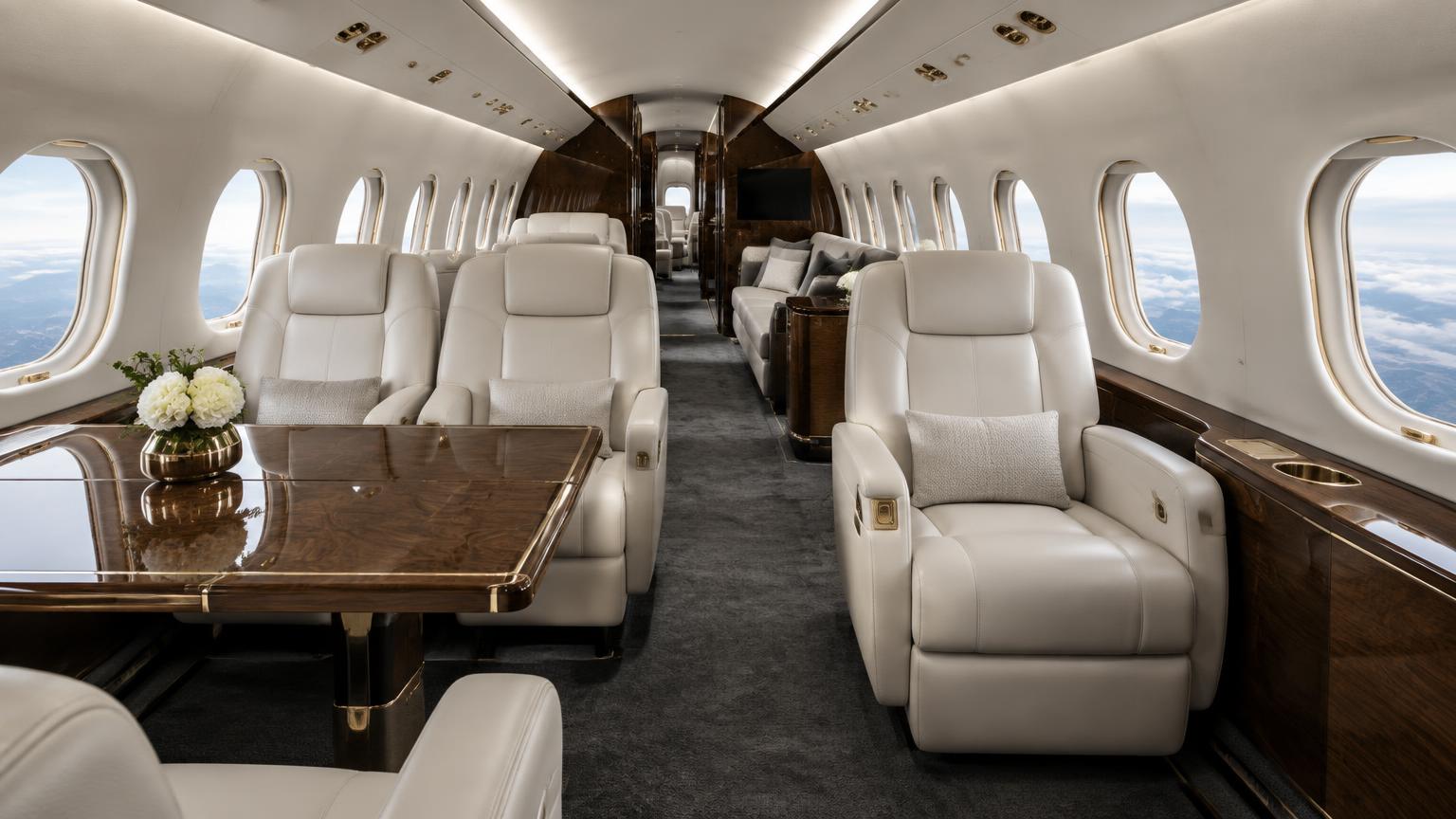
The illustrations are generated aviation imagery, not evidence of a specific aircraft or operator.
For a live itinerary, see the charter advisory guide or start a private enquiry.