What you actually buy
A fractional share is a part-ownership of a specific aircraft, sold as a number of flight hours a year. Flexjet’s European programme is a clear example: share sizes run from 1/16 (50 hours) to 1/2 (400 hours), each a slice of the 800 flight hours available per year on each aircraft. A one-eighth share therefore gives 100 hours, which Flexjet puts at approximately 80,000 kilometres a year.
In practice you are not buying a particular tail number so much as guaranteed access to a fleet. The aircraft you part-own may be flying someone else that afternoon; the provider sends you one of the same type, or better. The term is fixed: Flexjet sets a minimum of 30 months and a maximum of 60+ months, and at the end a portion of the share can be sold back to the provider.
The four lines on the invoice
Fractional pricing looks simple in a brochure and becomes clearer once you see the separate charges. Flexjet breaks it down into four parts:
- Capital cost: the purchase of the share itself, an asset purchase sized to the hours you want.
- Monthly fee: a fixed Monthly Flight Services Fee covering pilot training, insurance, cabin support, trip management and administration, whether you fly or not.
- Occupied hourly rate: charged for each hour an aircraft is in flight, plus a fixed taxi time, covering maintenance, standard catering and engine costs.
- Fuel component adjustment: added to the hourly rate to account for fluctuations in the cost of fuel, which varies monthly.
Who sells it in Europe
Europe’s fractional market is, in effect, two names. NetJets Europe is the largest operator of any kind on the continent: Avi-Go’s 2025 annual report credits it with 12.99% of European operator departures, 65,146 flights. In June 2026 it remained the #1 operator in Europe with a 12.05% share, while Flexjet ranked #3 with 2.56%.
Flexjet is the challenger with the visible investment. In September 2026 it opened a $34 million private terminal at Farnborough, open only to its fractional owners and their guests, which also serves as its European headquarters, alongside a new maintenance hangar at the same airport. Aviation Week describes Flexjet as the second largest fractional ownership provider, behind NetJets.
Why demand is rising
Honeywell’s 2025 outlook found that the world’s fractional fleet has grown by 65% since 2019, with light, midsize and super midsize aircraft making up about 80% of it. The buyers are not only private individuals: almost half of operators who already hold shares use them when they need to increase capacity, and 15% of operators are seriously considering buying fractional shares.
The clearest signal came this summer. NetJets curtailed sales of its jet card and lease products for the second time in five years, citing record-high retention rates, alongside increased (fractional) owner and market demand. Jet cards and its entry-level 25-hour leases had accounted for about 15% of its total flying. A new entrant, BOND, plans to sell 10 shares per aircraft instead of the industry standard 16 when it starts flying in early 2027. In my reading, the market is telling smaller users that fractional providers will prioritise their owners when capacity is tight.
The arithmetic against charter
Corporate Jet Investor put the trade-off plainly in its 2011 guide: for most private jet flights, charter companies are cheaper per flying hour than fractional companies, because a share brings the purchase price, a monthly management fee and an occupied hourly fee. The same guide quoted a US example for a Phenom 300: a 1/16 share at $537,500, a monthly fee of $6,998 and an occupied hourly rate of $1,454. Those are old American figures, not today’s European prices, but they show the structure well.
Do the sum on the fixed fees alone. Twelve monthly fees of $6,998 come to $83,976 a year. Spread over the 50 hours of a 1/16 share, that adds about $1,680 to every occupied hour; fly only 30 hours and it becomes about $2,800 an hour, before the capital, the depreciation of the share and fuel. That is the most important number in any fractional decision: not the quoted hourly rate, but total annual cost divided by the hours you will actually fly.
Where fractional wins is everything charter adds on top of the flying. Owners are billed for occupied hours, and Flexjet promises rates without ferry fees within its service areas. On charter, repositioning is part of the price, sometimes the larger part on a one-way trip; I explain why in the economics of repositioning. For a family flying many one-way sectors at short notice, that difference can close much of the gap.
The regulatory question worth asking
In Europe, the question that matters is whether a flight counts as commercial. EU rules define a commercial operation as one for remuneration that is available to the public or performed under a contract between an operator and a customer, where the latter has no control over the operator.
EASA’s guidance, quoted by the law firm Vedder Price, is that “control” should be read widely and that this is particularly valid for managed operations or fractional ownership: how much control the owners keep depends on the specific contract. The practical question for a buyer is simple. Ask under which certificate your flights will be operated, commercial under an AOC or non-commercial, and what that means for crew rules, oversight and insurance. The large providers will answer at once; be wary of any smaller scheme that cannot.
The exit is part of the price
A share is a commitment, and leaving early has a cost. Corporate Jet Investor’s guide described a typical five-year term, with an option to terminate the contract after three, a re-marketing fee at around 7 per cent of the share price in many programmes, and only a small amount of hours carried from one year to the next. Contract terms have moved on since 2011, so read today’s agreement line by line, but these are the clauses to look for.
Remember also that you own part of a depreciating asset. What you recover at the end depends on the aircraft’s market value then, not on what you paid. I track how values move in used private jet prices, and the whole-aircraft case is in charter versus owning.
Who it suits, in my view
Fractional ownership makes sense for a fairly narrow profile: someone who flies 50 hours or more a year, consistently, on one aircraft category, who values guaranteed availability on peak days and a familiar standard of aircraft and crew over the lowest price per flight. Flexjet itself says shared ownership is ideal for those flying 50 or more hours per year.
Between roughly 25 and 50 hours, a jet card usually fits better; I compare the two in jet card versus on-demand charter and set out current rates in jet card prices in Europe. Below that, or if your flying is irregular, mixes aircraft sizes or is planned well ahead, on-demand charter is normally the better value. Charter enquiries I take are fulfilled through Limitless Sky, and I am always happy to run a client’s last two years of flights through all three models before they sign anything.
Frequently asked questions
How many hours does a fractional jet share give you? — Shares are sold as a proportion of the aircraft’s annual hours. At Flexjet Europe each aircraft has 800 hours a year, so a 1/16 share gives 50 hours, a 1/8 share 100 hours and a 1/2 share 400 hours.
What fees does a fractional owner pay? — Typically four: the capital cost of the share, a fixed monthly fee for crew, insurance and management, an occupied hourly rate for each flight hour plus a fixed taxi time, and a fuel adjustment that varies monthly.
Is fractional ownership cheaper than chartering a private jet? — Usually not per flight hour, according to Corporate Jet Investor, because of the share price and fixed monthly fees. It can come closer for people who fly many one-way trips, because owners are not charged for repositioning within the provider’s service area.
Who offers fractional jet ownership in Europe? — The main providers are NetJets Europe, Europe’s largest operator with 12.99% of European operator departures in 2025 according to Avi-Go, and Flexjet, which opened an owners-only terminal at Farnborough in September 2026.
Planning a specific journey? Live charter enquiries are handled by Limitless Sky, where the operator, aircraft and terms for your itinerary can be discussed.
Sources & editorial notes
Written by Dr. Christoph Lymbersky as an authored perspective drawing on the public sources below. Sources reviewed 30 October 2026. General editorial guidance, not an individual operating, legal, tax or investment recommendation. Scenarios are labelled illustrative and do not describe real clients. No market-wide prices, statistics or guaranteed aircraft performance are asserted.
- Flexjet Europe — Shared (fractional) ownership programme ↗
Share sizes from 1/16 (50 hours) to 1/2 (400 hours) of the 800 flight hours available per aircraft per year; a 1/8 share gives 100 hours, about 80,000 km; minimum term 30 months, maximum 60+ months; costs split into capital cost, Monthly Flight Services Fee, occupied hourly rate plus a fixed taxi time, and a monthly fuel component adjustment; part of the share can be sold back at the end of the contract; no ferry fees within the Service Areas.
- Aviation Week — Flexjet Unveils Farnborough Terminal Marking Global Expansion (10 September 2026) ↗
$34 million private terminal at Farnborough open only to Flexjet fractional owners and guests, also Flexjet’s European headquarters, alongside a new maintenance hangar; Flexjet is the second-largest fractional provider behind NetJets, with more than 350 jets and helicopters.
- Forbes (Doug Gollan) — NetJets Curtails Jet Card Sales And Competitors See Opportunities (2 August 2026) ↗
NetJets limited jet card and lease sales for the second time in five years, citing record retention and increased fractional owner demand; jet cards and 25-hour leases about 15% of its flying; fleet of 868 jets as of July 2026; new fractional provider BOND to sell 10 shares per aircraft instead of the industry-standard 16, flying from early 2027.
- Corporate Jet Investor — Is fractional jet ownership right for you? (29 November 2011) ↗
Costs: share purchase price, monthly management fee and occupied hourly fee, without positioning charges; example (US, Flight Options, Phenom 300, 2011): 1/16 share $537,500, monthly fee $6,998, occupied hourly rate $1,454; typical five-year term with an option to exit after three; re-marketing fee around 7% of the share price; only limited carry-over of hours.
- EASA — FAQ: meaning of “control” in the definition of commercial operation, Regulation (EU) 965/2012 Article 2 ↗
‘Commercial operation’: an operation for remuneration that is available to the public or, when not available to the public, performed under a contract between an operator and a customer, where the latter has no control over the operator.
- Vedder Price via Lexology — EASA Part-NCC: What Do Financiers Need to Know? (27 July 2016) ↗
Quotes EASA guidance that “control” should be understood in a wider sense, including financial control and control of management decisions, a notion ‘particularly valid for managed operations or fractional ownership’; how much control owners keep depends on the specific contract with the management company.
- Avi-Go — 2025 Annual Business Aviation Report (RD200) ↗
Flight-tracking research on business jet departures, countries, airports and aircraft in 2025.
- Avi-Go — Research & Consulting ↗
Avi-Go periodic market research, including January–August 2025 and 2026 monthly European data.
- Honeywell — 2025 Global Business Aviation Outlook ↗
Manufacturer-published forecast of business jet demand; a forecast, not a measurement.
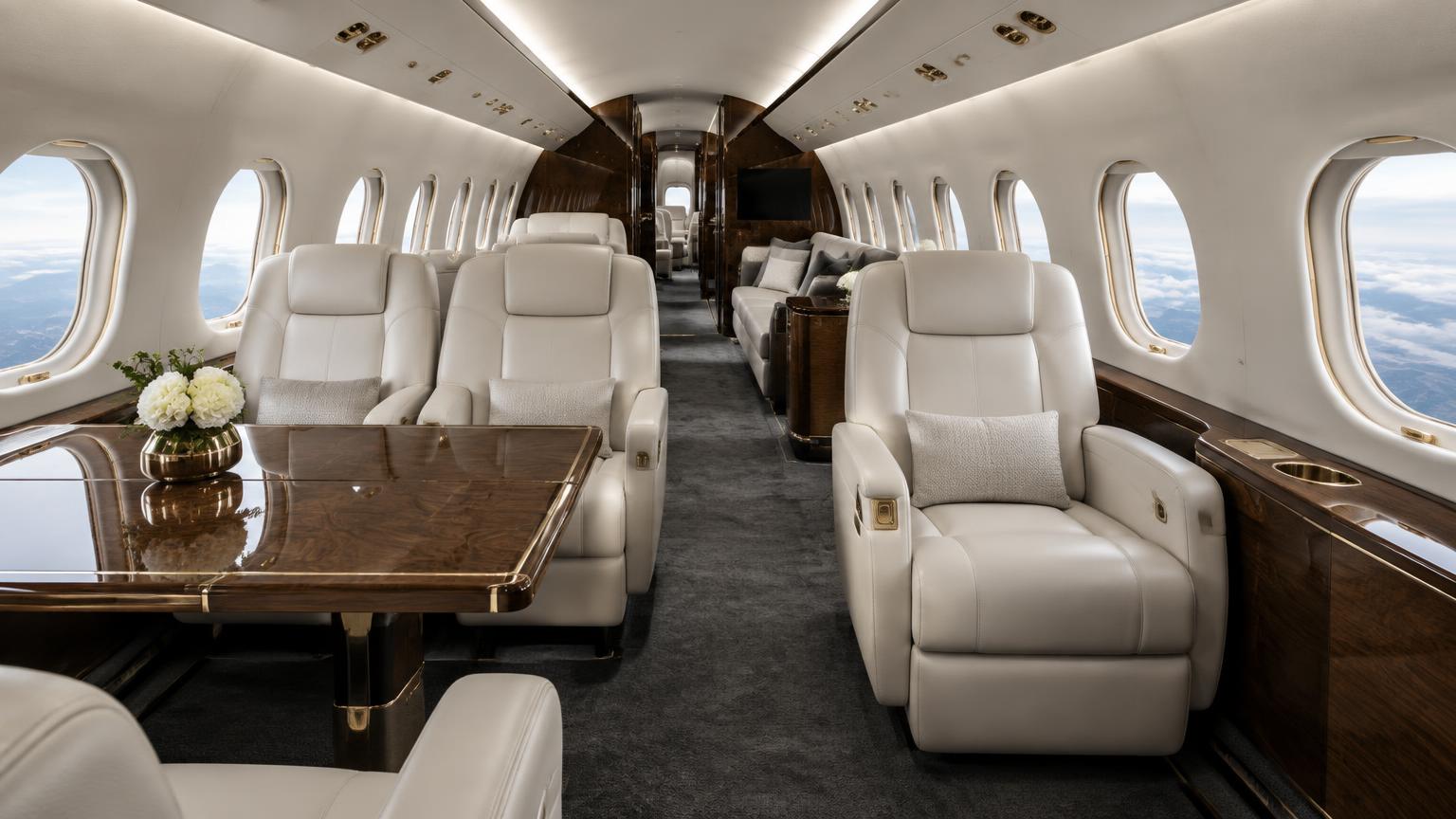
The illustrations are generated aviation imagery, not evidence of a specific aircraft or operator.
For a live itinerary, see the charter advisory guide or start a private enquiry.