Half the flying, not half the prestige
Avi-Go’s 2025 annual business aviation report records that light jets flew 51.19% of Europe’s business aviation departures in 2025 — 266,088 flights, even as the category declined 1.47% year on year. Globally, light jets were 47.59% of business jet flights in 2025 (1,673,098 departures). Europe is not an outlier; it is a clearer version of the same pattern.
The mid-year cut tells the same story with a slightly different definition of the universe. In January–August 2025, light jets accounted for 47.2% of European business jet movements — 184,682 flights. Midsize jets were the “missing middle” at 18.4% — 71,848 movements. Heavy jets were 14.9% (58,349 departures). Ultra-long-range types captured 18.3% of European movements in the same window — a larger share than in North America, because Europe still needs those aircraft for the long sectors and for owners who keep them based here. Volume, however, sits with the light cabin.
By June 2026 the balance had not flipped. Light jets accounted for 27,443 of 56,579 European departures — 48.5%. Midsize jets were 18.96%. If you fly privately in Europe with any regularity, the statistical default aircraft is a light jet.
Why Europe suits the light cabin
The route map explains the mix better than any sales argument. Europe’s busiest private corridors are short. London ↔ Paris was Europe’s busiest business aviation city pair in 2025, with 4,384 flights. London ↔ Nice, Geneva ↔ Paris, Nice ↔ Paris and the Alpine and Riviera feeders that sit just behind them are measured in tens or low hundreds of minutes, not in ocean crossings. I set those corridors out in more detail in my note on Europe’s busiest private jet routes.
On a flight of around an hour, a well-chosen light jet is often the rational aircraft: enough cabin for a small party, enough performance for the airport, and a lower cost of ownership and operation for the operator who has to keep the aircraft productive. That last point matters in a market where utilisation is already modest. Avi-Go estimates European business jets averaged about 7.6 flights per month per aircraft in January–August 2025, and flew empty on approximately 40% of sectors versus about 30% in North America. Operators that live on short European sectors favour types that are cheap enough to move often and flexible enough to use secondary airports.
Prestige and fitness are not the same thing. A large cabin on a ninety-minute sector can be pleasant. It is rarely necessary, and it is frequently more expensive once positioning is counted.
The European workhorses
Within the light-jet and near-light fleet, a handful of models do a disproportionate share of the work.
The Citation Excel/XLS/XLS+ family was Europe’s most active aircraft model in 2025, with 47,945 departures — 9.2% of European flights. In January–August 2025 the same family led European models with 32,602 movements and an 8.33% share. Cessna as a brand led European OEM share in that window at 32.7% — 126,957 movements across Citation families.
The Embraer Phenom 300 was Europe’s second most active model in January–August 2025, with 31,540 movements — an 8.06% share, after growing 2.81% from 30,678 movements. Globally it was the world’s most-flown light jet in 2025, with 262,365 departures and 15.68% of light-jet flights. Embraer as a brand captured 16.0% of European movements in January–August 2025 (62,273 flights), with heavy Phenom concentration.
The Pilatus PC-24 was Europe’s fourth most active model in 2025, with 29,585 flights, up 13.64% year on year — a distinctly European success, helped by runway flexibility that matters at Alpine and secondary fields.
Not every light type is rising. The Citation CJ1 was the steepest decliner among European models in January–August 2025, down 31.01% year on year (11,888 to 8,201 movements). Ageing subtypes lose share; the category does not.
Phenom 300: the charter workhorse in practice
If one type illustrates why light jets dominate European charter, it is the Phenom 300. On London ↔ Paris — Europe’s busiest corridor — the Phenom 300 led aircraft deployment in January–August 2025 at 8.86% of corridor movements, ahead of the Challenger 300 (6.95%) and the Citation Latitude (6.81%). That is a light jet outrunning midsize and super-midsize types on the route that defines European business aviation.
Utilisation tells the same story. In June 2026, Avi-Go ranked the Phenom 300 second by utilisation in Europe at 59.29%, across a 112-aircraft cohort. It ranked fourth in Europe by average monthly flight hours, at 66.9 hours per aircraft. In that same month it led Embraer’s European mix with 4,703 flights — 58.96% of the brand’s European activity. Globally it was model of the month in June 2026, with 25,894 flights. The Phenom alone accounted for 59.43% of all Embraer business jet flights in 2025 — the highest single-model brand concentration among major OEMs in that report.
Manufacturer performance, under Embraer’s stated assumptions for the Phenom 300E, includes a long-range cruise range of 2,010 nm with five occupants and NBAA IFR reserves with a 100 nm alternate, a high-speed cruise of 464 kt, MMO of Mach 0.80, and a takeoff distance of 3,209 ft at MTOW, sea level, ISA. Standard seating is typically one or two crew plus six passengers, with higher-density layouts available. Duncan Aviation’s Model/Market Summary, drawing on Conklin & de Decker / Vref, lists a normal cruise of 430 KTAS with typical cabin seating for seven, and an NBAA IFR seats-full range of 1,811 nm. Those two range figures are not a contradiction; they reflect different load and cruise assumptions. For a live charter, only the operator’s flight plan for your load, dates and airports counts — a point I labour in my note on range and reserve margins.
Used values and variable costs for the Phenom 300/E sit in my note on used private jet prices. Popularity matters there too: a deep fleet means crews, parts and buyers.
Citation versus Phenom — and when to step up
Clients often ask me to pick between a Citation light jet and a Phenom 300 as if the name alone decided the trip. It does not. The Excel/XLS family leads European volume; the Phenom leads many of the high-utilisation and corridor lists. Within Cessna’s light lineup, utilisation varies by subtype: in June 2026 the Citation CJ2 Europe cohort ran at 50.13% activity across 76 aircraft, while the Citation CJ3 cohort was at 42.98% across 47 aircraft. Category labels hide real differences between airframes.
My practical frame is simple:
- Favour a light jet when the party is small, the sector is intra-European, baggage is modest, and the airports suit the type. Most London–Paris, Geneva–Paris, domestic Italian or German hops, and many Riviera sectors fall here.
- Compare specific airframes, not brands. Cabin height, lavatory arrangement, baggage door size and year of interior matter more than the model name on the quote. See luggage, cabin and runway and choosing aircraft categories.
- Step to midsize or larger when you need a stand-up cabin for work, more baggage volume, a longer nonstop with reserves, or a runway/hot-and-high case that squeezes the light jet. Midsize is only about one flight in five in Europe; that does not make it rare on the days you need it — it makes it a deliberate choice.
- Do not buy prestige for a short sector. Positioning a large-cabin aircraft into a ninety-minute European hop often costs more than the cabin improves the journey.
What this means if you charter in Europe
The following is my advice as a broker, not a finding from the datasets above.
- Start with the mission, not the cabin photograph. Give passenger count, baggage inventory, airports and timing first. A light jet will be the right answer more often than the brochure shelf implies.
- On Europe’s trunk routes, light-jet availability is usually deep. That does not mean every light jet is equal. Ask for the registration, the operator and the cabin configuration.
- In peak summer, book early even for light jets. Category share does not create spare capacity on the Riviera in July. The aircraft still have to be in the right place; empty-sector rates in Europe remain high.
- Treat “Citation versus Phenom” as a comparison of offers. Price the same itinerary on both, with the same inclusions, and decide on the actual aircraft and operator.
- Keep a larger type for the missions that need it. Intercontinental sectors, large parties and rest-critical overnight flights are where midsize, super-midsize and heavy jets earn their keep. Europe’s ultra-long-range share exists for a reason; it should not be the default for a Geneva lunch.
My view, briefly
Europe’s private aviation is often sold through the imagery of the largest cabins. The flight data says something quieter and more useful: light jets do most of the work, the Citation Excel family and the Phenom 300 do much of that work, and the Phenom in particular has become the charter workhorse on the continent’s busiest short corridors. Clients who accept that fact early get better-fitting aircraft, cleaner quotes and fewer conversations about why a flagship was “unavailable” for a trip that never needed one.
Frequently asked questions
What share of Europe’s private flying is done by light jets? — Avi-Go’s 2025 annual report puts light jets at 51.19% of Europe’s business aviation departures (266,088 flights). In January–August 2025 they were 47.2% of movements; in June 2026 they were 48.5% of European departures.
Which light jet flies most in Europe? — By model volume, the Citation Excel/XLS/XLS+ family led Europe in 2025 with 47,945 departures. The Embraer Phenom 300 ranked second in January–August 2025 with 31,540 movements (8.06% share) and leads many utilisation and corridor rankings, including London–Paris.
Is the Embraer Phenom 300 a good charter choice in Europe? — For short and medium European sectors with a modest party, often yes. It was the world’s most-flown light jet in 2025, Europe’s second most active model in January–August 2025, and the leading type on London–Paris in that window. Suitability still depends on the specific airframe, operator, baggage and airports.
Citation or Phenom for a European charter? — Compare specific offers. The Excel/XLS family leads European volume; the Phenom leads several utilisation and corridor measures. Cabin layout, baggage, year, operator and positioning usually decide the quote more than the brand name.
When should I book a midsize or larger jet in Europe? — When cabin height, baggage volume, passenger count, nonstop range with reserves, or airport performance require it. Midsize jets were about 18–19% of European activity in recent Avi-Go windows — common enough to find, deliberate enough not to default to.
Planning a specific journey? Live charter enquiries are handled by Limitless Sky, where the operator, aircraft and terms for your itinerary can be discussed.
Sources & editorial notes
Written by Dr. Christoph Lymbersky as an authored perspective drawing on the public sources below. Sources reviewed 11 October 2026. General editorial guidance, not an individual operating, legal, tax or investment recommendation. Scenarios are labelled illustrative and do not describe real clients. No market-wide prices, statistics or guaranteed aircraft performance are asserted.
- Avi-Go — 2025 Annual Business Aviation Report (RD200) ↗
Flight-tracking research on business jet departures, countries, airports and aircraft in 2025.
- Avi-Go — Research & Consulting ↗
Avi-Go periodic market research, including January–August 2025 and 2026 monthly European data.
- Embraer — Phenom 300E brochure (2025) ↗
Manufacturer performance under stated assumptions (range, speed, takeoff distance, seating). Not a guarantee for any individual charter flight.
- Duncan Aviation — Business Jet Model/Market Summary ↗
Vref value ranges and variable cost per hour by model. Values are indicative, not appraisals.
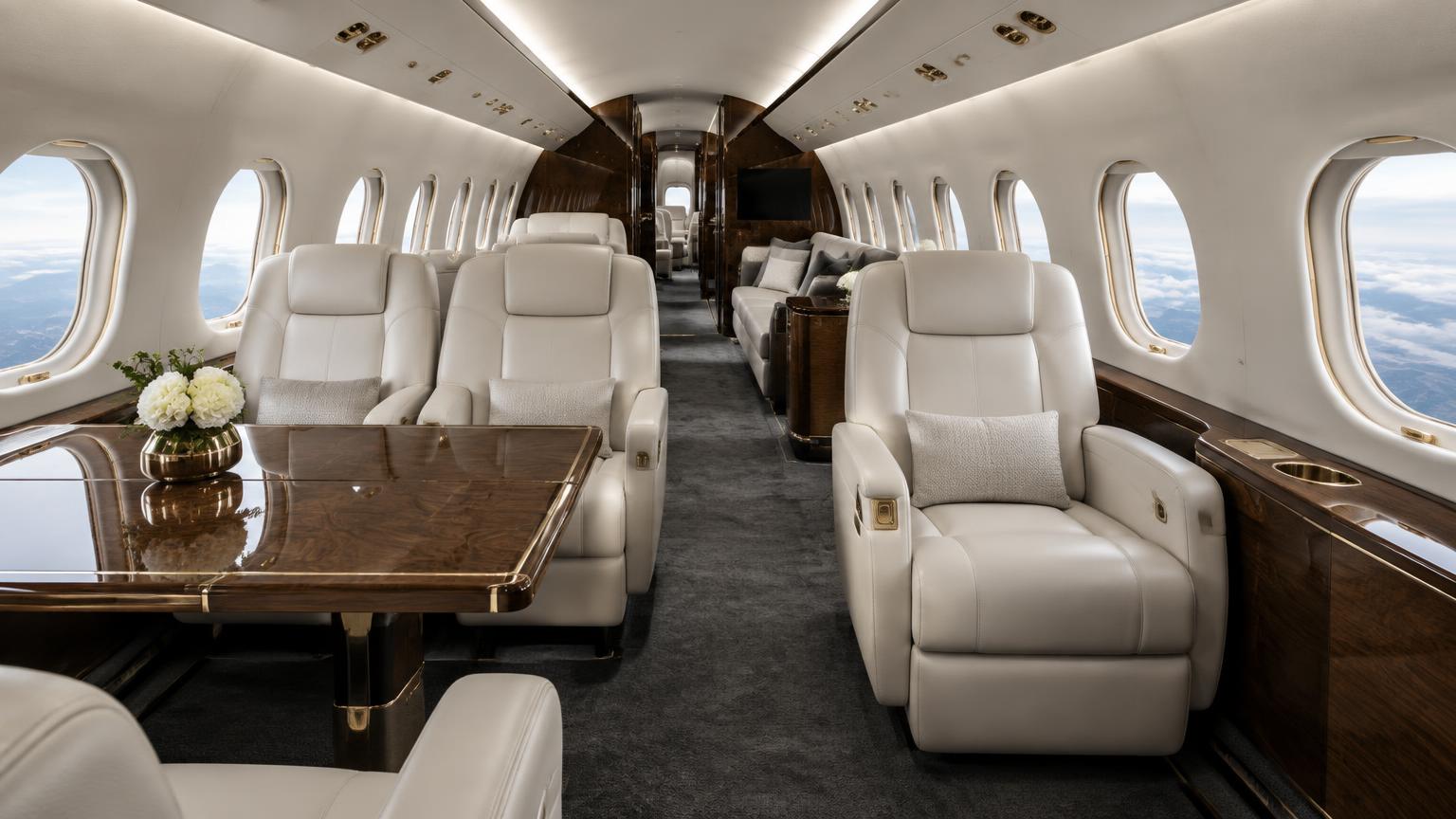
The illustrations are generated aviation imagery, not evidence of a specific aircraft or operator.
For a live itinerary, see the charter advisory guide or start a private enquiry.