Why de-icing is not optional
The rule is blunt. Under US Part 135, which governs on-demand charter, no pilot may take off with frost, ice or snow adhering to the wings, control surfaces, propellers or windshield, with only narrow exceptions. European rules are built on the same clean-aircraft principle. Even a thin layer of frost changes how a wing produces lift, and snow adds weight and can restrict the controls.
That is why the decision belongs to the captain, not to the passenger or the broker. PrivateFly’s own advice to clients is never to argue against a de-ice, and I give the same advice. If a crew decides the aircraft needs treatment, the only sensible question is how quickly it can be done.
Type I and Type IV, and why the clock matters
Two kinds of fluid do most of the work. Type I is applied heated and removes existing frost, snow and ice, but gives minimal protection against new contamination. Type IV is an anti-icing fluid that stays on the aircraft and protects it for a limited time after application, the so-called holdover time. In falling snow, a crew may need both, which is a two-step treatment and a larger bill.
The clock is where money is lost. The whole process usually takes 10 to 30 minutes, depending on aircraft size and the fluid needed, and if the departure is delayed after treatment, the protection can run out and the aircraft may have to be sprayed again. A passenger who arrives forty minutes late on a snowy morning can, quite literally, pay twice.
Who pays on a private jet charter
On an on-demand charter, the client does. Because nobody can predict whether, or how much, fluid will be needed, PrivateFly describes it as industry standard practice that the client is liable after the flight, invoiced at cost price. Air Charter Advisors puts it the same way: the charge is billed by the handler or FBO and passed on to the passengers at cost, and it is never in the original quotation.
It is also missing from the price benchmarks. Jet Supply’s European charter index states that de-icing, peak-day pricing and special catering can come on top of its figures. When I compare quotes in winter, I read the de-icing clause before the hourly rate; how I read the rest of a quote is in all-in price versus hourly rate. A quote that appears to include de-icing deserves a second look: someone is either pricing the risk in, or has not thought about it.
What de-icing a private jet costs in 2026–27
The bill is mostly fluid, and fluid is priced airport by airport. Icarus Jet collected prices from service providers at five US business aviation airports ahead of this winter: Type I from $31.00 a gallon at Teterboro to $43.00 at Aspen, and Type IV from $36.00 at Chicago Executive to $47.40 at Aspen. For the same hypothetical 100 gallons of Type I and 50 of Type IV, the fluid alone came to $4,950 at Teterboro and $6,670 at Aspen, before equipment, labour, minimum charges and taxes.
European airports often add a flat fee to the fluid. Airport St. Gallen-Altenrhein’s tariff, valid from 1 April 2026, charges a de-icing flat fee by weight, CHF 378 for aircraft of 6 to 12 tonnes, plus CHF 10.40 per litre of Type I or Type II sprayed, excluding VAT. By my arithmetic, 300 litres on an aircraft in that weight band would come to CHF 3,498 before VAT. The same tariff also levies a winter operations surcharge on every landing from 1 October to 31 March, whether or not the aircraft is de-iced.
For a rule of thumb by size, PrivateFly gives an average of about €1,000 per application for a small jet, and more than €10,000 for larger aircraft. Treat any single figure as a starting point: snow, freezing rain and a second application can all multiply it.
- Fluid volume: driven by aircraft size, how much snow or ice is on it, and whether one or two steps are needed.
- Airport price: per gallon or per litre, with or without a flat or set-up fee.
- Timing: a delay after treatment can mean a second application.
- Extras: minimum charges, equipment, labour and VAT, depending on the provider.
Waivers, jet cards and hangars
There are three ways to take the uncertainty out. The first is a waiver: PrivateFly sells one priced as a share of the predicted cost, often around €150 per flight on a small jet; without it, it asks for a deferred card charge of at least €1,500 before the flight. The second is a jet card that includes it: PrivateFly’s fixed-rate programme lists de-icing as included. Whether a card makes sense overall is a different question, which I discuss in jet card versus on-demand charter.
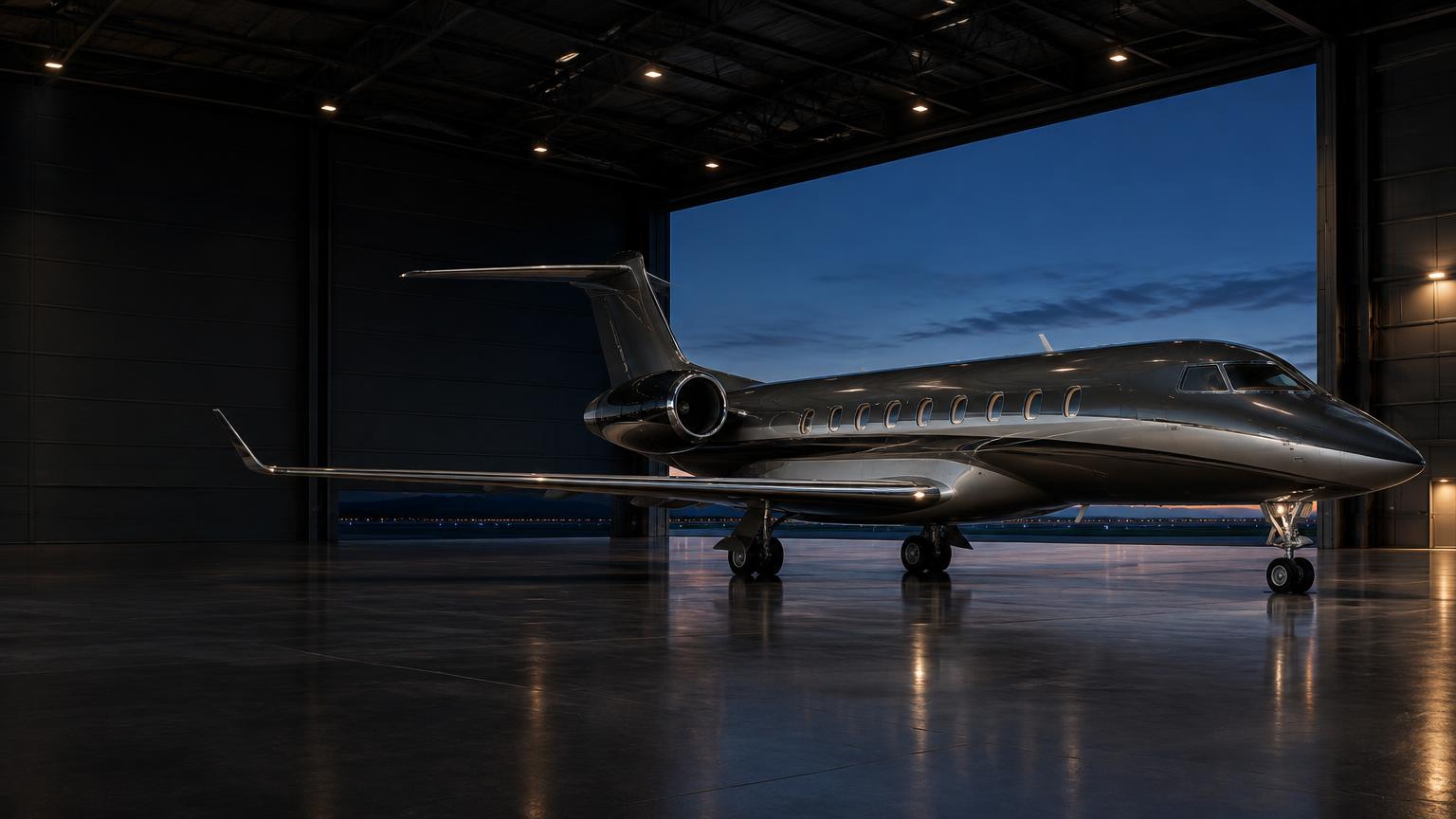
The third is a hangar. An aircraft kept inside overnight needs little or no fluid, and PrivateFly notes that an hour in a heated hangar will often melt the ice completely. The catch is that hangar space is scarce on the busiest winter weekends, and at some airports overnight hangarage costs more than the de-icing it avoids. I ask for both prices before choosing.
How I keep de-icing under control
On a winter trip I do four things. I ask the operator the evening before whether de-icing is expected and whether a hangar is available. I agree a firm arrival time at the terminal, so that the treatment is timed to the departure rather than to a guess. Where there is a choice of airport, I compare the fluid price and fees, because they differ more than people expect. And I build the de-icing risk into the client’s budget from the start, rather than presenting it as a surprise afterwards.
In the Alps, this matters more than anywhere else in Europe. Mountain airports have short winter hours and little margin for a queue at the de-icing rig, which I cover in private jets for the ski season. In Geneva, the usual winter gateway, the business aviation handlers offer de-icing and hangarage alongside customs. If a departure is lost to weather altogether, the contract terms decide who pays for what, as I explain in charter disruption costs.
Frequently asked questions
How much does it cost to de-ice a private jet? — PrivateFly gives an average of about €1,000 per application for a small jet and more than €10,000 for larger aircraft. In the US, Icarus Jet found 2026–27 fluid prices of $31.00 to $43.00 a gallon for Type I and $36.00 to $47.40 for Type IV at five airports.
Who pays for de-icing on a private jet charter? — On an on-demand charter, the client, usually invoiced at cost after the flight. Some jet card programmes, such as PrivateFly’s, include it in the hourly rate.
Is de-icing included in a charter quote? — Normally not. It depends on the weather at departure, so it is billed afterwards. Price indices such as Jet Supply’s also exclude it.
How long does de-icing take? — Usually 10 to 30 minutes, depending on aircraft size and fluid type. If the departure is delayed after treatment, the aircraft may need to be treated again.
Can I avoid de-icing costs? — A hangar overnight, or an hour in a heated hangar, often avoids most of it. A de-icing waiver or a jet card that includes de-icing removes the uncertainty.
Planning a specific journey? Live charter enquiries are handled by Limitless Sky, where the operator, aircraft and terms for your itinerary can be discussed.
Sources & editorial notes
Written by Dr. Christoph Lymbersky as an authored perspective drawing on the public sources below. Sources reviewed 14 November 2026.
General guidance, not individual legal, tax or investment advice. Figures come from the sources below unless marked as my own calculation. Client examples are anonymized.
- eCFR — 14 CFR 135.227, Icing conditions: Operating limitations ↗
No pilot may take off an aircraft that has frost, ice or snow adhering to any rotor blade, propeller, windshield, stabilizing or control surface, powerplant installation, flight instrument system or wing, with narrow exceptions.
- PrivateFly — De-icing for private jets and De-icing Waiver ↗
On-demand charter clients are liable for ground de-icing after the flight, invoiced at cost (industry standard); average about €1,000 per application for a small jet, over €10,000 for larger aircraft; waiver often about €150 per flight on a small jet, otherwise a deferred card charge of at least €1,500; jet card clients do not pay de-icing; an hour in a heated hangar often melts the ice; hangarage can cost more than de-icing.
- Icarus Jet — Private Jet Deicing Costs in 2026–2027 at US Airports (5 November 2026) ↗
Prices collected from service providers for winter 2026–27, USD per gallon: Type I $31.00 (Teterboro) to $43.00 (Aspen); Type IV $36.00 (Chicago Executive) to $47.40 (Aspen); hypothetical 100 gal Type I + 50 gal Type IV = $4,950 at Teterboro, $6,670 at Aspen, before equipment, labour, minimums and taxes.
- Airport Altenrhein AG — Tariff Regulations valid from 1 April 2026 ↗
Annex E: de-icing/anti-icing flat fee by MTOW (CHF 126 up to 3 t, 252 up to 6 t, 378 up to 12 t, 504 up to 24 t, 787 up to 40 t, 945 up to 50 t, 1,050 above), plus CHF 10.40 per litre of Type I/Type II sprayed, excluding VAT; winter operation surcharge on every landing 1 October–31 March whether or not de-icing is used (home-based and up to 3 t exempt).
- Air Charter Advisors — De-icing and hangaring for private jets (FAQ) ↗
De-icing is billed by the handler or FBO after the flight and passed on to passengers at cost; never included in charter quotations; the process usually takes 10–30 minutes; delays after application can require re-application.
- Jet Supply — European Private Jet Charter Price Index Q4 2026, revised 1 November 2026 ↗
Revised bands per hour in the air for the whole aircraft, crew and fuel included, positioning, airport and handling fees and taxes excluded: midsize jet (Learjet 60XR, Hawker 900XP) €5,300–€7,000; super midsize jet (Challenger 350, Praetor 600, G280) €6,000–€9,000, mid-band €7,500; super light jet €4,000–€6,000; London–Mykonos (3h 30m, super midsize) flight only from €21,000, typical all-in €37,000–€52,000 one way; not comparable with the Q3 2026 edition.
- Private Jet Card Comparisons — PrivateFly rebrands jet card under Aviator (March 2024) ↗
European fixed-rate programme: 20% surcharge on 35 peak days, waived when booked at least 14 days ahead; no blackout dates; de-icing included; funds never expire but are non-refundable; entry point $200,000.
The illustrations are generated aviation imagery, not evidence of a specific aircraft or operator.
For a live itinerary, see the charter advisory guide or start a private enquiry.