Palma: the island’s one jet airport
Palma de Mallorca (PMI, ICAO LEPA) is the airport for every private jet I would put on the island. The Spanish AIP gives it two runways, 3,270 m and 3,000 m long, both 45 m wide, and lists the airport, customs and immigration, fuel and handling as open 24 hours. Runway length is never the limiting factor here; from a light jet to a long-range Gulfstream, Palma can take the aircraft.
It is also one of Europe’s busiest airports for business aviation in its own right. Avi-Go placed Palma among Europe’s ten busiest business aviation airports in January–August 2025, in a year when Spain was one of the strongest large markets in Europe, up 6.55% to 52,434 business jet departures. Around it runs a much larger airline airport: Aena counted 33,806,427 passengers and 246,486 take-offs and landings at Palma in 2025, with Germany the largest international market at 9,837,735 passengers, ahead of the United Kingdom at 5,921,981 and Switzerland at 1,303,533.
Private passengers do not pass through the main terminal. The AIP names the authorised general and business aviation managers (FBOs) for the general aviation terminal, Aviapartner Palma de Mallorca FBO and Mallorcair, and makes a handling agent compulsory for every general and business aviation flight. Note one gap: the AIP lists no hangar space, so in winter the aircraft stays outside.
Son Bonet is not a jet airport
Clients who know the island sometimes ask about Son Bonet (LESB), the old airfield a few kilometres north-west of Palma. On paper it is closer to the city; in practice it is not an option for a charter jet. Its AIP entry authorises visual flight rules only, on a runway 23 m wide with a take-off run of 1,263 m to 1,299 m and a landing distance of 1,080 m to 1,116 m, and lists no customs and immigration service. Aena describes it as an airfield for general and sport aviation only, with no commercial traffic, open from sunrise to sunset.
My reading: Son Bonet serves light aircraft, flying schools and some helicopter traffic. No commercial jet charter I would arrange would be planned into it, and I would be wary of anyone who offered one.
Palma’s rules, and why summer is different
Palma is a slot-coordinated airport all year. The Spanish AIP lists it among the coordinated airports without a seasonal qualifier, whereas Ibiza and Menorca are coordinated only in the summer season; a business flight to Mallorca in November needs a slot as much as one in July. The summer adds rules specific to private aviation, which the AIP explains by the limited capacity of the general aviation apron:
- From 1 April to 30 September, a private flight must request the arrival and the departure together, with the aircraft’s registration, ICAO type, length and wingspan; the slot is not authorised until coordination is confirmed.
- From 1 June to 30 September, an aircraft longer than 20 m may park on the general aviation apron for at most seven days, unless the airport expressly authorises more.
- When the apron is full, the airport may coordinate only a stop of up to three hours, to drop passengers and refuel, with at least one crew member on board.
- If an arriving flight does not match its slot in time, type or date, the airport reserves the right to refuse the coordinated stay and allow only three hours.
- Night hours for noise purposes run 21:00–05:00 UTC in summer and 22:00–06:00 UTC in winter, which is 23:00 to 07:00 local time all year by my conversion.
What the 20-metre line means in practice
The seven-day limit applies by length, so the aircraft type matters. Embraer gives the Phenom 300E an overall length of 15.64 m and a wingspan of 15.91 m; Bombardier gives the Challenger 3500 a length of 20.9 m and a wingspan of 21.0 m. A light jet sits under the line; a super-midsize jet such as the Challenger is above it.
For a long weekend, none of this matters. For a ten-day summer stay in a super-midsize or larger jet, it does: either the airport authorises the longer stay, or the aircraft leaves and comes back, and those two extra empty sectors are paid for. I set out how that arithmetic works in my note on repositioning. In July and August I agree with the operator, before I confirm the aircraft, whether it stays, leaves or is released for other work.
Ibiza and Menorca: the other Balearic gateways
Ibiza (IBZ, LEIB) has a single runway, 2,799 m by 45 m, and is the island’s only jet gateway, as well as the way to Formentera. Its airport director told Cadena SER that private jet operations at Ibiza grew 2.5% in 2025, and that Ibiza remains the second-busiest Spanish airport for private jets, behind Mallorca. The peak is sharp: Avi-Go recorded Ibiza’s movements rising 57.95% from May to June 2026, to 2,137.
Ibiza’s rules are written around wingspan rather than length. From 1 May to 15 October, a general aviation aircraft with a wingspan over 18 m stopping for more than three hours must request its stand in advance through a handling agent, and the slot request then requires prior parking authorisation from the airport. The Phenom 300E’s 15.91 m is under that line; the Challenger 3500’s 21.0 m is over it. Ibiza is also open 24 hours only until 31 October; from 1 November its hours are 06:30–23:00 (AIP times, in UTC), which matters for a late return in winter.
Menorca (MAH) is, like Ibiza, slot-coordinated in the summer season. Between the islands the distances are short, by my own great-circle arithmetic about 75 nm from Palma to Ibiza and about 71 nm from Palma to Menorca; for a single island hop, a helicopter or a boat often makes more sense than a jet. If the trip includes a yacht, the same planning applies as in my note on coordinating yacht and jet charter.
Distances from Germany, Switzerland and London
These are great-circle distances by my own arithmetic, with no winds, routing or alternates; illustrative, not flight plans:
- Geneva to Palma: about 430 nm. Zurich to Palma: about 540 nm.
- Stuttgart to Palma: about 615 nm. Munich: about 655 nm. Frankfurt: about 675 nm.
- Düsseldorf to Palma: about 725 nm. Berlin or Hamburg: about 890 to 895 nm.
- London Farnborough or Luton to Palma: about 720 to 750 nm.
- All of these are within the range of a modern light jet. Which light jet I choose for Hamburg–Palma with four aboard, and why, I explain in my note comparing the CJ3+ and the CJ4.
What it costs
Jet Supply’s European index, revised on 1 November 2026, puts light jets at €3,200 to €5,000 and super light jets at €4,000 to €6,000 per hour in the air, crew and fuel included, with positioning, airport and handling fees and taxes on top. The index has no Mallorca route, but it prices Ibiza: London to Ibiza on a super light jet, 2h 10m, from €8,700 for the flying, typically €17,000 to €24,500 all-in one way, and Paris to Ibiza, 1h 55m, typically €15,500 to €22,000. London–Palma is a slightly shorter sector than London–Ibiza, so I would expect a similar band for it; that is my inference, not a published figure.
Two things move a Mallorca price more than the hourly rate. The first is the season: from June to September aircraft flow south, and a one-way trip often pays for the aircraft to fly home empty. The second is the date pattern; a Friday-to-Sunday weekend in July competes with every other weekend flight to the Mediterranean. If your dates are flexible, it is worth asking about empty legs; an aircraft that has just dropped other passengers on the island has to fly home somehow.
Arriving from London, and other details
Palma is in Schengen. A flight from Germany, Switzerland or France arrives as an internal Schengen flight; a flight from London or from outside Europe arrives at an external border, with passport control by the Spanish authorities. Since April 2026 that means the EU’s Entry/Exit System for non-EU passengers, which I describe in my note on EES and ETIAS. Palma’s customs and immigration are open around the clock; Son Bonet has none, which is one more reason it is not an option for an arrival from the UK.
Two practical points. Ask the operator for the slot confirmation, not merely the quote; in summer a quote without a confirmed slot and parking is a hope. And state the real passenger list and departure time early, because a late change of time or aircraft is exactly what lets Palma shorten a coordinated stay to three hours.
My view, briefly
Mallorca is an easy destination for a private jet in winter and a well-run but crowded one in summer. Fly into Palma, not Son Bonet. From April to September, treat the slot and the parking as part of the booking, not an afterthought; for a long stay in a jet over 20 m, decide in advance whether the aircraft stays or repositions. And if the plan includes Ibiza or Menorca, check the wingspan as well as the runway.
Planning a flight to Mallorca or Ibiza
Charter enquiries I take are fulfilled through Limitless Sky, whose pages cover Mallorca and Palma and Ibiza. Send me the dates, the party and the length of the stay, and I will set out two or three aircraft with the full price for each, and confirm the slot and the parking at Palma before I confirm the aircraft.
Frequently asked questions
Which airport do private jets use on Mallorca? — Palma de Mallorca (PMI/LEPA). It has two runways of 3,270 m and 3,000 m, an FBO terminal for private passengers, and customs and immigration around the clock. Son Bonet is a daylight, visual-rules airfield for light aircraft.
Can a private jet land at Son Bonet? — Not as a charter jet in practice. The AIP limits Son Bonet to visual flight rules, on a 23 m wide runway with about 1,300 m of take-off run, and lists no customs or immigration.
Do I need a slot for a private jet to Palma? — Yes, all year: Palma is a coordinated airport in winter and summer. From 1 April to 30 September the request must cover arrival and departure together, with the aircraft’s registration, type, length and wingspan.
How long can a private jet stay in Palma in summer? — From 1 June to 30 September, an aircraft longer than 20 m may park on the general aviation apron for at most seven days unless the airport authorises more. When the apron is full, only a three-hour stop may be coordinated.
How much does a private jet to Mallorca cost? — Jet Supply’s November 2026 index puts light jets at €3,200 to €5,000 per hour in the air, before positioning, fees and taxes, and prices London to Ibiza on a super light jet at typically €17,000 to €24,500 all-in one way. Season and the empty return usually decide the final figure.
How far is Mallorca from Germany by private jet? — By great-circle distance, about 655 nm from Munich, 675 nm from Frankfurt and 895 nm from Hamburg, all within the range of a modern light jet.
Planning a specific journey? Live charter enquiries are handled by Limitless Sky, where the operator, aircraft and terms for your itinerary can be discussed.
Sources & editorial notes
Written by Dr. Christoph Lymbersky as an authored perspective drawing on the public sources below. Sources reviewed 25 November 2026.
General guidance, not individual legal, tax or investment advice. Figures come from the sources below unless marked as my own calculation. Client examples are anonymized.
- ENAIRE — AIP Spain AD 2-LEPA/LESJ, Palma de Mallorca (AIRAC AMDT 10/26, in force from 29 October 2026) ↗
Runways 06L/24R 3,270 x 45 m and 06R/24L 3,000 x 45 m; airport, customs and immigration, fuel and handling H24; no hangar space; authorised general and business aviation FBOs Aviapartner Palma de Mallorca FBO and Mallorcair; handling agent mandatory for general and business aviation; 1 April–30 September GA slot requests must cover arrival and departure with registration, ICAO type, length and wingspan, not authorised until coordination is confirmed; 1 June–30 September maximum 7 days on the GA apron for aircraft over 20 m long unless authorised; when the apron is full, 3-hour stops with a crew member on board; night hours 2100–0500 UTC (summer), 2200–0600 UTC (winter).
- ENAIRE — AIP España AD 2-LESB, Mallorca/Son Bonet (AIRAC AMDT 10/26, in force from 29 October 2026) ↗
Aena aerodrome, VFR traffic only; runway 05/23 23 m wide, TORA 1,263 m / 1,299 m, LDA 1,080 m / 1,116 m; no customs and immigration service.
- Aena — Aeropuerto de Son Bonet, preguntas frecuentes ↗
No commercial traffic; general and sport aviation only (private traffic and flying schools); visual aerodrome open from sunrise to sunset; flight plan mandatory.
- ENAIRE — AIP Spain AD 2-LEIB, Ibiza ↗
Runway 06/24 2,799 x 45 m; airport H24 in summer and until 31 October, from 1 November 0630–2300 (UTC); handling mandatory for general and business aviation; 1 May–15 October GA aircraft with wingspan over 18 m stopping more than 3 hours must request the stand in advance via a handling agent, and the slot request requires prior parking authorisation.
- ENAIRE — AIP España GEN 1.2, coordinación de slots aeroportuarios (AECFA) ↗
AECFA coordinates slots under Regulation (EEC) No 95/93; coordinated airports include Palma de Mallorca (no seasonal qualifier), and Ibiza and Menorca in the summer season.
- Aena — El Aeropuerto de Palma de Mallorca cierra 2025 con 33,8 millones de pasajeros (13 January 2026) ↗
33,806,427 passengers in 2025 (+1.5%); 246,486 take-offs and landings (+1.4%); largest international markets Germany 9,837,735 passengers, United Kingdom 5,921,981, Switzerland 1,303,533.
- Aena — El Aeropuerto de Ibiza contabiliza en 2025 más de 9 millones de pasajeros (13 January 2026) ↗
9,138,224 passengers in 2025 (+0.7%); 85,086 take-offs and landings (+2.5%).
- Cadena SER / Radio Ibiza — La aviación privada creció un 2,5% en el aeropuerto de Ibiza en 2025 (12 February 2026) ↗
Airport director Marta Torres: private jet operations at Ibiza grew 2.5% in 2025; Ibiza remains Spain’s second-busiest airport for private jets, behind Mallorca.
- Embraer — Phenom 300E brochure (2025) ↗
Manufacturer data: overall length 15.64 m (51 ft 4 in), wingspan 15.91 m (52 ft 2 in), height 5.10 m.
- Bombardier — Challenger 3500 brochure (2021) ↗
Manufacturer data: length 20.9 m (68 ft 8 in), wingspan 21.0 m (69 ft 0 in).
- Avi-Go — Research & Consulting ↗
Avi-Go periodic market research, including January–August 2025 and 2026 monthly European data.
- Avi-Go — 2025 Annual Business Aviation Report (RD200) ↗
Flight-tracking research on business jet departures, countries, airports and aircraft in 2025.
- Jet Supply — European Private Jet Charter Price Index Q4 2026, revised 1 November 2026 ↗
Revised bands per hour in the air for the whole aircraft, crew and fuel included, positioning, airport and handling fees and taxes excluded: midsize jet (Learjet 60XR, Hawker 900XP) €5,300–€7,000; super midsize jet (Challenger 350, Praetor 600, G280) €6,000–€9,000, mid-band €7,500; super light jet €4,000–€6,000; London–Mykonos (3h 30m, super midsize) flight only from €21,000, typical all-in €37,000–€52,000 one way; not comparable with the Q3 2026 edition.
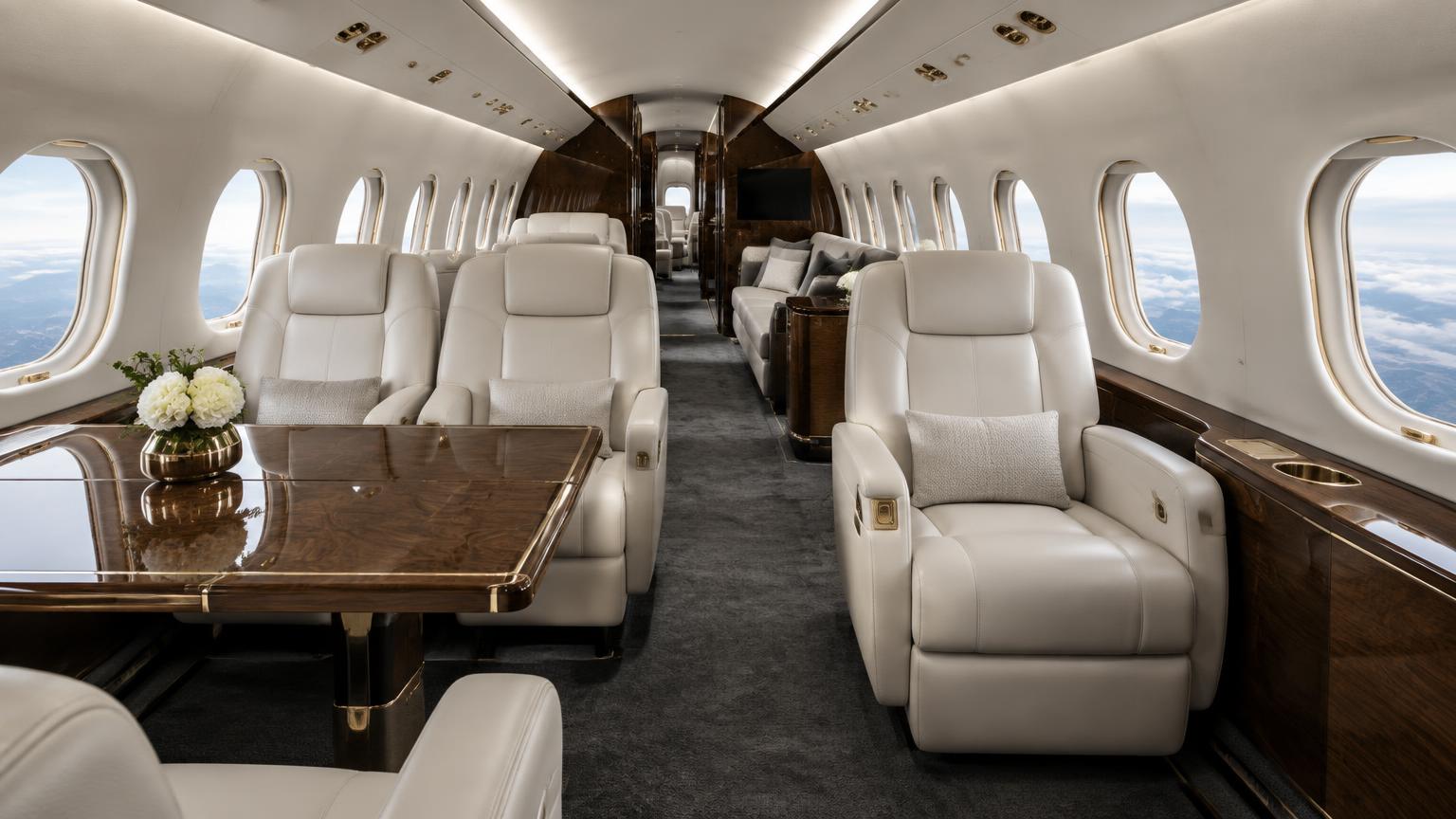
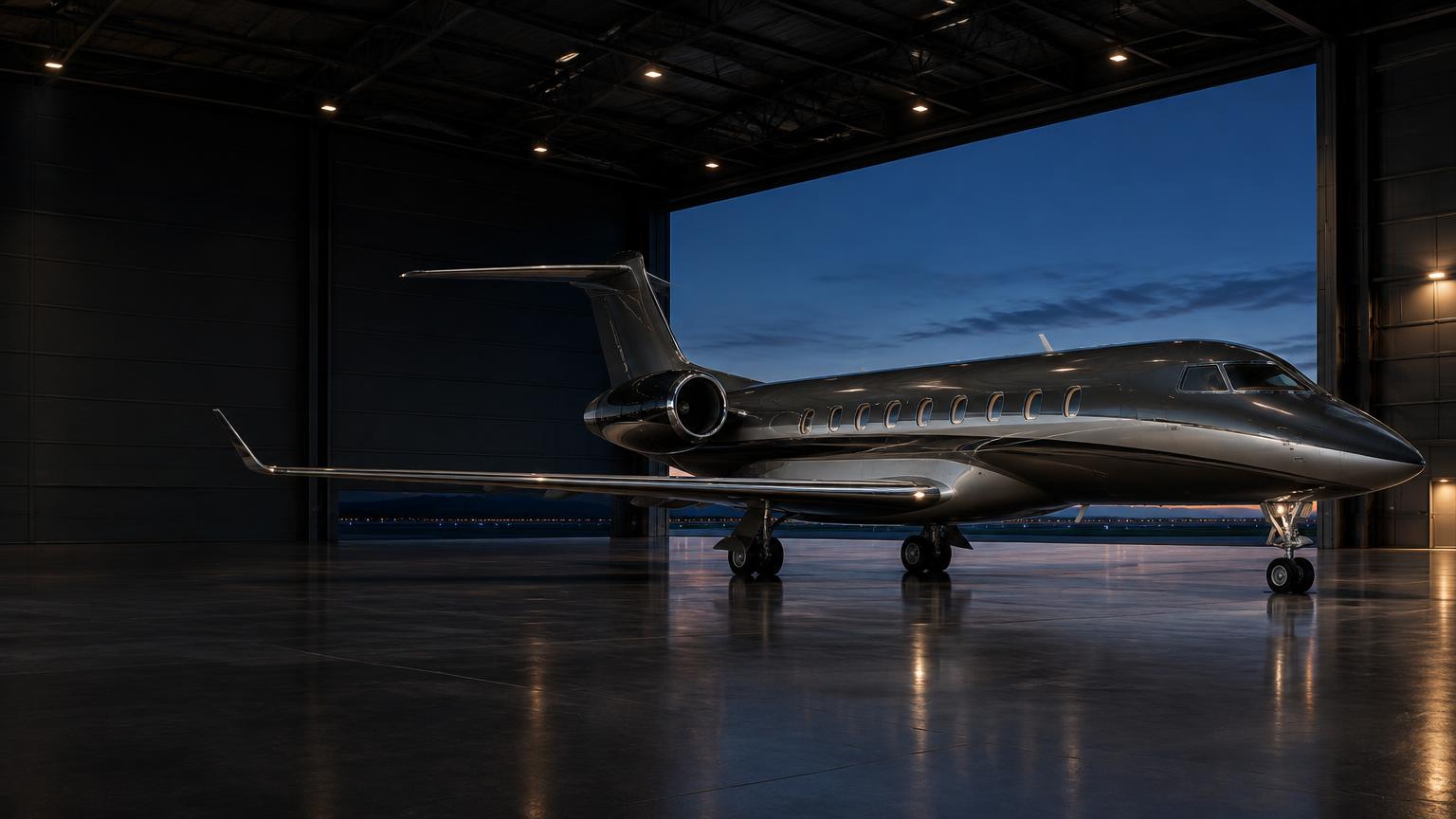
The illustrations are generated aviation imagery, not evidence of a specific aircraft or operator.
For a live itinerary, see the charter advisory guide or start a private enquiry.