One family, several names
The XLS+ is one chapter in a long book. Duncan Aviation’s October 2026 summary lists the Citation Excel (1998–2004), the Citation XLS (2004–2009) and the Citation XLS+ (2008–present), all sharing the same cabin dimensions. Textron calls the lineage the 560XL series and says it has delivered more than 1,000 Cessna Citation 560XL series aircraft since 2000.
The latest chapter is the Citation Ascend. Aviation Week describes it as the newest business jet in the Citation 560XL series, one that replaces the Citation XLS Gen 2. For a charter client this matters less than it sounds: almost every aircraft you will be offered in Europe today is an Excel, an XLS or an XLS+, and the name on the quote should tell you which.
Why it is everywhere in Europe
The numbers are unusually clear. Avi-Go’s 2025 annual report names the Citation Excel/XLS/XLS+ Europe’s most active aircraft model in 2025, with 47,945 departures — 9.2% of European flights. In January–August 2025 the family led European models with 32,602 movements and an 8.33% share, and on Europe’s top 1,000 city pairs it led at 8.67% of movements.
It is also worked hard. In Avi-Go’s June 2026 data the European fleet ranked third by utilisation, at 58.05% across 130 aircraft, and it flew 5,285 flights, 48.87% of all Cessna flying in Europe that month. ch-aviation counts 148 Citation 560XL aircraft in Europe. A fleet that size, spread across many operators, is the practical reason I see it so often: when an aircraft goes technical on the morning of a flight, another XLS is usually not far away.
One caution on the trend. The same Avi-Go dataset shows the family down 6.53% year on year in January–August 2025. My reading is that newer types, such as the PC-24, are winning some of the work it used to do by default. It is still the volume leader, but no longer the automatic choice. I compare those light jets in why light jets do most of Europe’s private flying.
The cabin: stand-up height at a light-jet scale
The XLS+ is classed as a midsize jet by Duncan, but its real competition in Europe is the top of the light-jet market. Duncan’s figures, set side by side:
- Citation XLS+: cabin 18.5 ft long, 5.5 ft wide and 5.7 ft high; 422 cu ft; 90 cu ft of baggage; typically 8 seats.
- Embraer Phenom 300/E: 17.17 × 5.08 × 4.92 ft; 324 cu ft; 85 cu ft of baggage; 7 seats.
- Pilatus PC-24: 23 × 5.58 × 5.08 ft; 501 cu ft; 90 cu ft of baggage; 6 seats.
- Citation Latitude: 21.75 × 6.42 × 6.0 ft; 587 cu ft; 127 cu ft of baggage; 9 seats.
Reading the comparison
All figures above are from Duncan Aviation’s Business Jet Model/Market Summary, current as of October 2026. By my arithmetic, the XLS+ cabin is about 30% larger than the Phenom 300’s, and at 5.7 ft (about 1.74 m) it is the one in this group where most adults can stand, or nearly so. The PC-24 is longer and has about 19% more volume, but less height. Baggage is similar across the three; the PC-24’s cargo door, which I describe in my note on the PC-24, handles bulky items better.
What the XLS+ gives you, in practice, is a cabin where four people can sit facing each other and still move about. For four business travellers on a two-hour sector it is a comfortable office. For eight with skis it is not, and the operator’s actual configuration should be on the quote.
Range and payload: the honest limitation
This is where the XLS+ gives ground, and where the brochure picture can mislead. Duncan lists an NBAA IFR seats-full range of 1,528 nm for the XLS+, against 1,811 nm for the Phenom 300/E and 1,525 nm for the PC-24. By my arithmetic the bigger-cabin Citation flies about 16% less far than the Phenom with every seat filled. Payload with full fuel is 860 lb for the XLS+, against 1,361 lb for the Phenom.
In European terms that is still ample for most of what clients fly: London to Nice, Geneva or Ibiza, Paris to the Côte d’Azur, Munich to Olbia. It runs out on long sectors with a full cabin: Hamburg to Tenerife is roughly 1,930 nm by my great-circle estimate, beyond the seats-full figure before winds and reserves, so a fuel stop or a larger aircraft is the honest answer. Published range is a planning figure, not a promise; the operator’s flight plan for the day decides, as I explain in realistic range and reserve margins.
What it costs to run, and to charter
Duncan’s October 2026 summary estimates total variable cost per hour, with fuel at $5.69 a gallon and routine maintenance but no major inspections, at $3,815 for the Citation XLS+, against $3,086 for the Phenom 300/E, $2,775 for the PC-24 and $4,681 for the Citation Latitude. Its average fuel burn is 230 gallons per hour, against 169 for the Phenom. By my arithmetic the XLS+ costs about 24% more per hour to run than a Phenom 300 and burns about 36% more fuel; stepping up to a Latitude adds another 23% or so.
Charter pricing reflects that. Jet Supply’s Q4 2026 European index places the PC-24 and the Citation XLS+ together in a super light jet class at €6,400 to €9,900 per block hour, a mid-band of €8,150, against €6,100 for light jets such as the Phenom 300. Its route benchmarks put London to Nice, 1h 42m block time, from €13,000 all-in on a super light jet, and London to Ibiza from €15,500, one way for the whole aircraft. These are indicative from-prices; a live quote moves with date, positioning and the specific aircraft.
Buying one: wide spread, old and new
The family covers almost thirty years, and values show it. Duncan’s Vref ranges are $2,576k–$3,919k for the Excel, $3,785k–$5,005k for the XLS and $6,104k–$16,072k for the XLS+. The new Ascend is priced at $18.2 million, according to Aviation Week.
Deliveries of the outgoing model were modest in 2025. GAMA’s 2025 report shows 13 Citation XLS+ Gen2 and 3 Citation Ascend deliveries, against 47 Citation Latitudes. For an owner, the wide value range is the point: an older XLS can be bought for a fraction of a new aircraft, but Duncan puts its running costs close to the XLS+ ($3,734 an hour), and its avionics are older. I set out how values and operating costs interact in what used private jets are really worth.
The Citation Ascend, and what changes
The Ascend brings a new cockpit and cabin to the family. Textron lists the Garmin G5000 avionics suite with autothrottle, a flat-floor cabin and new PW545D engines, and publishes a four-passenger range of 1,940 nm with NBAA IFR reserves, a full fuel payload of 900 lb and a take-off field length of 3,800 ft at maximum take-off weight, sea level. Its cabin is 66 in wide and 60 in high, or 68 in with the option. Manufacturer figures and Duncan’s are compiled differently, so I would not compare them line by line.
For Europe, the date matters more than the brochure. Deliveries began with the first retail customer on December 30 2025, and NetJets took its first three in May 2026. FlightSafety said in February that EASA certification is planned for the third quarter of 2026; ch-aviation reported in May that the Ascend was yet to formally enter the European market as it awaits EASA certification. Textron also told ch-aviation it kept the CE-560XL type rating, which should make it easier for European XLS operators to bring crews across. Until Ascends are on European air operator certificates in numbers, the aircraft you charter here will be the XLS+ and its predecessors.
When I recommend the XLS+, and when I don’t
Charter enquiries I take are fulfilled through Limitless Sky. When the XLS+ is on the shortlist, I weigh four things:
- Cabin over price: four to six passengers on sectors of one to three hours who want to stand, move and work. Here the XLS+ often gives the most cabin for the money in Europe.
- Short, busy routes: London, Paris, Geneva and Nice, where the fleet is deep and a replacement aircraft can be found at short notice.
- Not for long sectors full: with all seats filled, a Phenom 300 flies further, and a Latitude or a super-midsize is the better tool for three-and-a-half hours and more. I compare those in midsize versus super-midsize jets.
- Ask which one: Excel, XLS or XLS+, the year of manufacture and the avionics. Same cabin, different aircraft, and the quote should say so.
My view, briefly
The Citation XLS+ is not glamorous and does not need to be. It is the aircraft that does Europe’s work: a stand-up cabin, a fleet big enough to recover from a bad morning and running costs that sit between a top light jet and a true midsize. Its weakness is range with a full cabin, and the honest answer on a long sector is sometimes a different aircraft. The Ascend should keep the family relevant for another decade, but until it is certified and flying in Europe, I would rather book a well-kept XLS+ already in position than wait for the new one.
Frequently asked questions
How far can a Citation XLS+ fly? — Duncan Aviation lists an NBAA IFR range of 1,528 nm with seats full and 1,976 nm as a ferry flight with no passengers. In practice, that covers London to Nice, Geneva or Ibiza comfortably; long sectors with a full cabin may need a fuel stop.
How many passengers does a Citation XLS+ seat? — Duncan lists a typical cabin of 8 seats. The operator’s actual configuration varies and should be confirmed on the quote.
How much does it cost to charter a Citation XLS+ in Europe? — Jet Supply’s Q4 2026 index places it in a super light class at €6,400 to €9,900 per block hour all-in, with London to Nice from €13,000 one way for the whole aircraft.
What is the difference between the Citation XLS+ and the Ascend? — The Ascend is the newest member of the same 560XL family, replacing the XLS Gen 2, with a Garmin G5000 cockpit, a flat-floor cabin and new engines. As of ch-aviation’s May 2026 report it was still awaiting EASA certification.
Planning a specific journey? Live charter enquiries are handled by Limitless Sky, where the operator, aircraft and terms for your itinerary can be discussed.
Sources & editorial notes
Written by Dr. Christoph Lymbersky as an authored perspective drawing on the public sources below. Sources reviewed 28 October 2026. General editorial guidance, not an individual operating, legal, tax or investment recommendation. Scenarios are labelled illustrative and do not describe real clients. No market-wide prices, statistics or guaranteed aircraft performance are asserted.
- Duncan Aviation — Business Jet Model/Market Summary ↗
Vref value ranges and variable cost per hour by model. Values are indicative, not appraisals.
- Avi-Go — 2025 Annual Business Aviation Report (RD200) ↗
Flight-tracking research on business jet departures, countries, airports and aircraft in 2025.
- Avi-Go — Research & Consulting ↗
Avi-Go periodic market research, including January–August 2025 and 2026 monthly European data.
- Jet Supply — European Private Jet Charter Price Index Q4 2026 (October 2026) ↗
Q4 2026 edition carries forward the Q3 bands: all-in per block hour, light jet €4,700–7,500 (mid-band €6,100), super midsize €8,900–15,300 (€12,100), ultra long range €14,300–22,500 (€18,400); 1.5-hour billing minimum; London–Paris 52-minute block from €8,300; excludes de-icing, special catering and peak-date surcharges.
- GAMA — 2025 Year-End Aircraft Shipments and Billings Report ↗
General Aviation Manufacturers Association delivery data by manufacturer and model for 2025.
- Textron Aviation — Cessna Citation Ascend specifications ↗
Manufacturer data: four-passenger range 1,940 nm (NBAA IFR reserves, 100 nm alternate), maximum cruise 441 ktas, up to 12 passengers, full-fuel payload 900 lb, take-off field length 3,800 ft at MTOW, sea level; cabin 18 ft 6 in long, 66 in wide, 60 in high (68 in optional); baggage 90.2 cu ft. Not a guarantee for any individual charter flight.
- Textron Aviation — Cessna Citation Ascend enters into service (31 December 2025) ↗
First retail delivery on 30 December 2025 after FAA type certification in November 2025; more than 1,000 Citation 560XL series aircraft delivered since 2000; Garmin G5000 cockpit with autothrottle, flat-floor cabin, PW545D engines; 18-month or 800-hour airframe maintenance interval.
- Aviation Week — NetJets Takes Delivery Of First Three Citation Ascends (5 May 2026) ↗
Seven Ascends delivered in 2026 as of 5 May, three to NetJets; the Ascend is the newest Citation 560XL series jet and replaces the Citation XLS Gen 2; priced at $18.2 million, configurable for 7–12 passengers.
- ch-aviation — Textron Aviation sees Europe as market match for Ascend (4 May 2026) ↗
148 Citation 560XL aircraft in Europe per ch-aviation data; the Ascend keeps the CE-560XL type rating; at the time it was yet to formally enter the European market as it awaited EASA certification; Textron calls Europe the most popular region for the Ascend.
- FlightSafety International — FAA approval for first Citation Ascend full-flight simulator (19 February 2026) ↗
Ascend pilot training scheduled from February 2026; EASA certification planned for the third quarter of 2026.
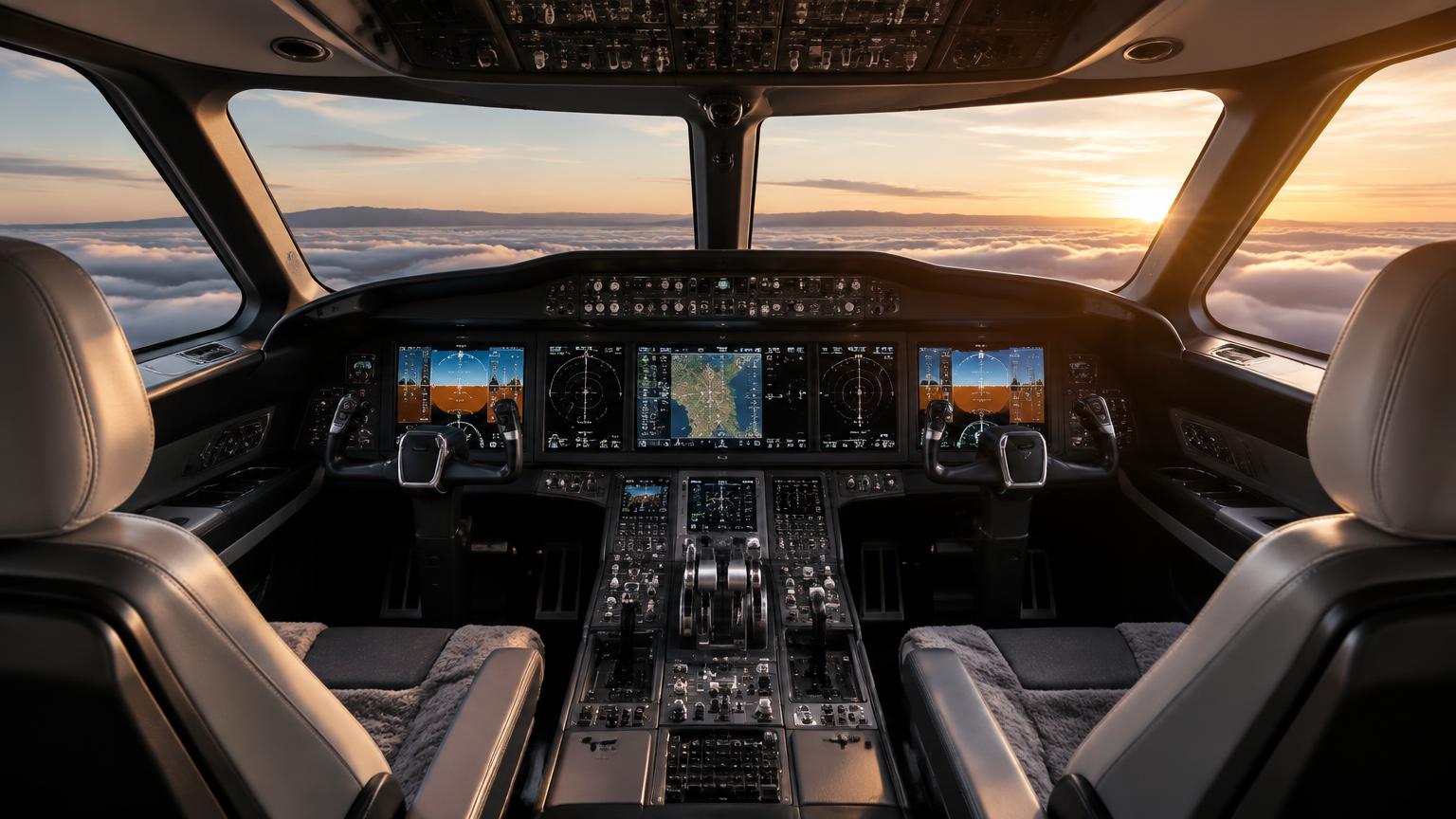
The illustrations are generated aviation imagery, not evidence of a specific aircraft or operator.
For a live itinerary, see the charter advisory guide or start a private enquiry.