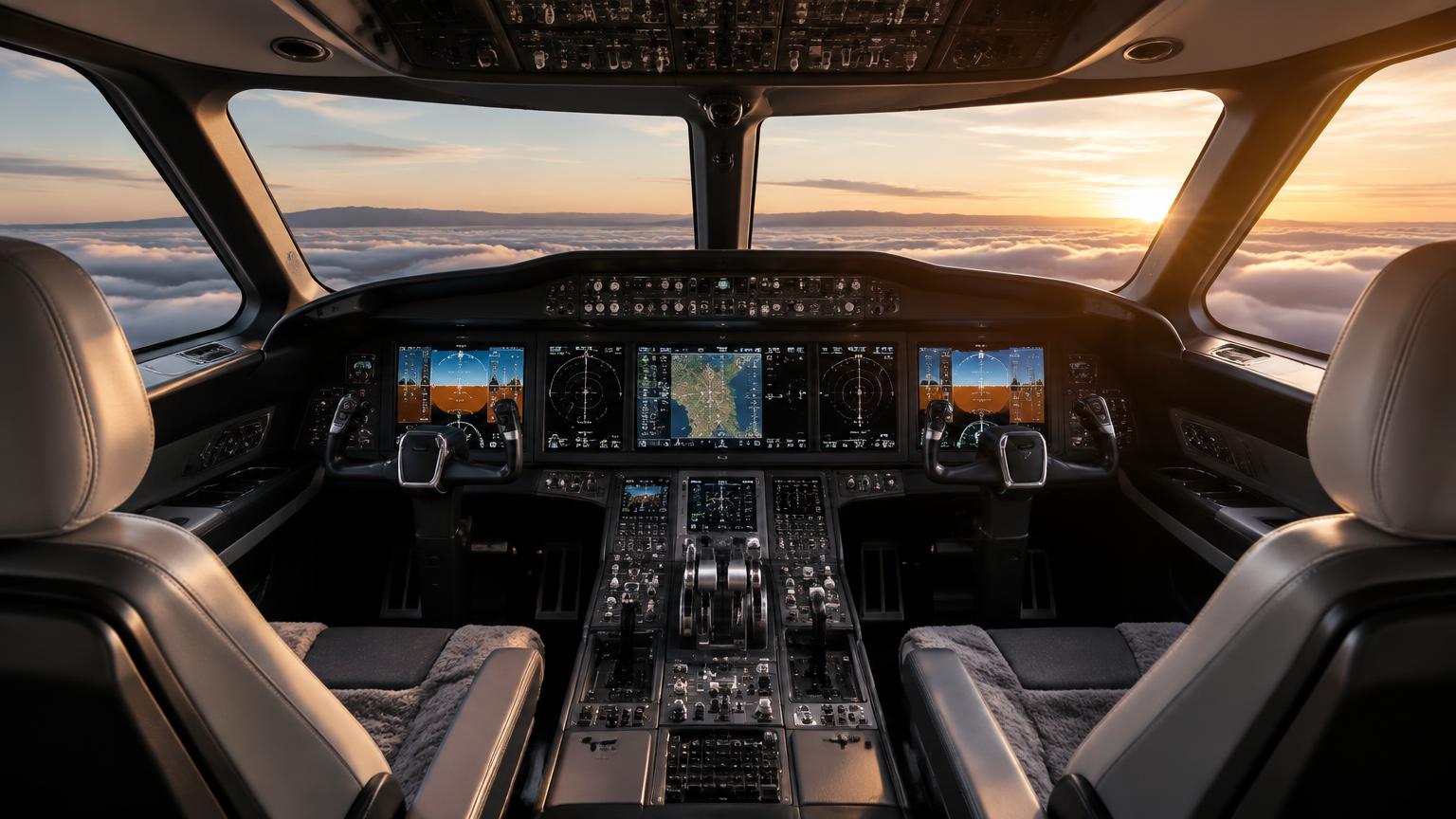
Different design emphases
Dassault presents the Falcon 8X as a long-range trijet with a flexible cabin and capability at demanding airports. The G650 family was developed as Gulfstream’s ultra-long-range, high-speed flagship of its generation.
These emphases matter only insofar as they affect your route. Neither is universally “better.”
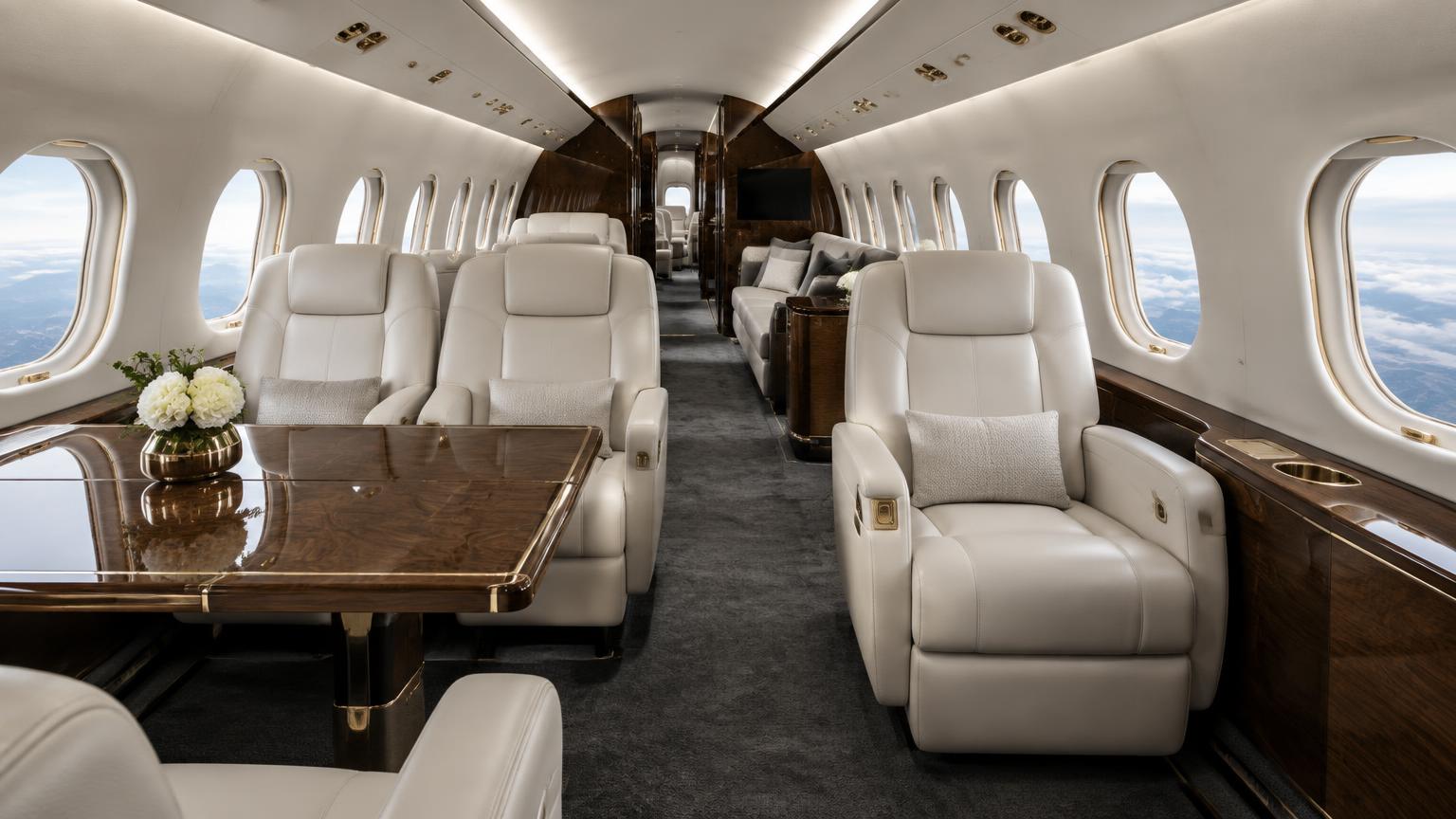
Cabin character
Cabin differences between individual aircraft can exceed differences between types. Seating, galley, lavatory position, berthing and connectivity depend on how each aircraft was configured and refurbished.
Ask for the actual floor plan and recent photographs of the specific aircraft offered.
Airport access
If your mission involves a shorter runway, a high-elevation airport or hot conditions, airport performance becomes decisive. Dassault emphasises the Falcon 8X’s access to challenging airports; the actual capability on a given day depends on weight, temperature and elevation.
Ask the operator to confirm performance for your airports. See runway performance.
Range margin
Where the route sits comfortably within both aircraft’s practical range, range should not drive the decision. Where it sits near the limit, the operator’s flight plan for the specific load and season is the only reliable guide.
This note deliberately avoids restating specification figures. Manufacturer data reflects stated assumptions; the operator’s flight planning for the actual aircraft, load, route and weather is authoritative.
Mission profiles that favour each
Without restating specifications, it is possible to describe the kinds of missions where each type is commonly considered. The Falcon 8X is often considered where airport access is a priority—shorter runways, high elevations or noise-sensitive airports—alongside long range. The G650 family is often considered where high-speed, ultra-long-range capability is the priority.
These are tendencies, not rules. The specific aircraft, load and conditions determine the outcome, which is why the operator’s performance calculation must decide the question.
Three engines versus two
The Falcon 8X has three engines; the G650 has two. Both configurations are certified for the operations they perform, and modern twin-engine aircraft routinely fly long overwater routes under applicable rules. Engine count should not be presented as a simple safety ranking. For a charter client, the more relevant factors are the operator’s standards, the crew and the suitability of the aircraft for the specific mission.
Comparison checklist
Ask both operators the same questions so that the answers are comparable.
- Can the aircraft operate from my airports at my expected weight and temperature?
- Is the route within comfortable practical range, including alternates?
- What is the cabin layout and how many passengers can sleep flat?
- What connectivity is installed and where does it work?
- Year of manufacture and last refurbishment?
- Where is the aircraft based and what positioning is required?
- Operator name, authority and audit status?
- Total price with matching inclusions and terms?
Avoiding false precision
Online comparisons often present tables of range, speed and cabin dimensions to several significant figures. Those figures are manufacturer values under stated assumptions and say little about a particular charter flight. A good decision uses them as background, then relies on the operator’s plan for the actual mission. See realistic range and reserves.
Availability, operators and the real shortlist
In practice, the choice is often made for you by availability. On a given date, there may be one suitably positioned Falcon 8X and no G650, or the reverse. The more useful framing is therefore not “which type is better?” but “which of the aircraft actually available fits my mission, and which operator do I trust to fly it?”
Operator quality deserves at least as much attention as type. Ask how the operator’s authority was verified, whether a third-party audit is cited and how recent it is, and how the operator handles disruption. A well-run operator with a slightly less ideal aircraft can deliver a better journey than a poorly run operator with the preferred type. See credibility checks and operator relationships for how brokers form that view.
Finally, consider the return. If your outbound and return have different requirements—more passengers on one leg, a demanding airport on the other—the right aircraft may differ by leg, and a broker can quote them separately.
Common misconceptions
The goal is not to declare a winner between two capable aircraft, but to find out which available aircraft best fits your route, airports and passengers.
- “Three engines means safer.” Both types are certified for their operations; operator standards matter more.
- “The faster aircraft always saves meaningful time.” On many routes the difference is modest compared with ground time.
- “Specification tables settle the comparison.” They describe types under assumptions, not your flight.
- “Cabin photographs show what I will get.” Confirm the configuration of the specific aircraft offered.
Making the decision
If your airports are demanding—short, high, hot or noise-restricted—start by asking each operator to confirm performance at your expected weight and time of day. If one aircraft requires a payload or fuel restriction and the other does not, that may settle the matter.
If both can perform the mission comfortably, compare the specific cabins, connectivity, positioning and total price. At that point the decision is closer to a matter of preference and value than of capability, and either aircraft may be a sound choice. See runway and cabin considerations for the information to provide.
Comparing offers fairly
Compare total price, positioning, cancellation terms, operator and configuration. A Falcon 8X positioned nearby may outperform a G650 requiring a long empty leg, and vice versa.
- Same passengers and baggage assumed in both quotes?
- Same inclusions (handling, de-icing, catering)?
- Positioning costs shown or embedded?
- Operator and registration named?
Sources & editorial notes
Written by Dr. Christoph Lymbersky as an authored perspective drawing on the public sources below. Sources reviewed 9 October 2026. General editorial guidance, not an individual operating, legal, tax or investment recommendation. Scenarios are labelled illustrative and do not describe real clients. No market-wide prices, statistics or guaranteed aircraft performance are asserted.
- Dassault Falcon — Falcon 8X ↗
Manufacturer page. Figures depend on configuration and stated assumptions.
- Gulfstream — Aircraft overview ↗
Manufacturer overview of the current-production fleet. The G650 family is no longer in the current-production lineup; data for an individual G650 should come from its operator and flight manual.
- eCFR — 14 CFR Part 135 Subpart I, Airplane Performance Operating Limitations ↗
US performance rules covering takeoff and landing limitations for commercial operations.
- FAA — Pilot’s Handbook of Aeronautical Knowledge ↗
Background on how weight, temperature and airport elevation affect aircraft performance.
The illustrations are generated aviation imagery, not evidence of a specific aircraft or operator.
For a live itinerary, see the charter advisory guide or start a private enquiry.