Two generations, one decision
The G650 and G650ER established Gulfstream’s ultra-long-range flagship position. Gulfstream’s current-production fleet is now led by the G700 and G800, and the G650 family no longer appears in its current lineup. Many G650-family aircraft remain in service, including on charter certificates.
That means you are rarely choosing between two models in the abstract. You are choosing between specific airframes, each with its own age, cabin, connectivity and operator.
Cabin: how will you use it?
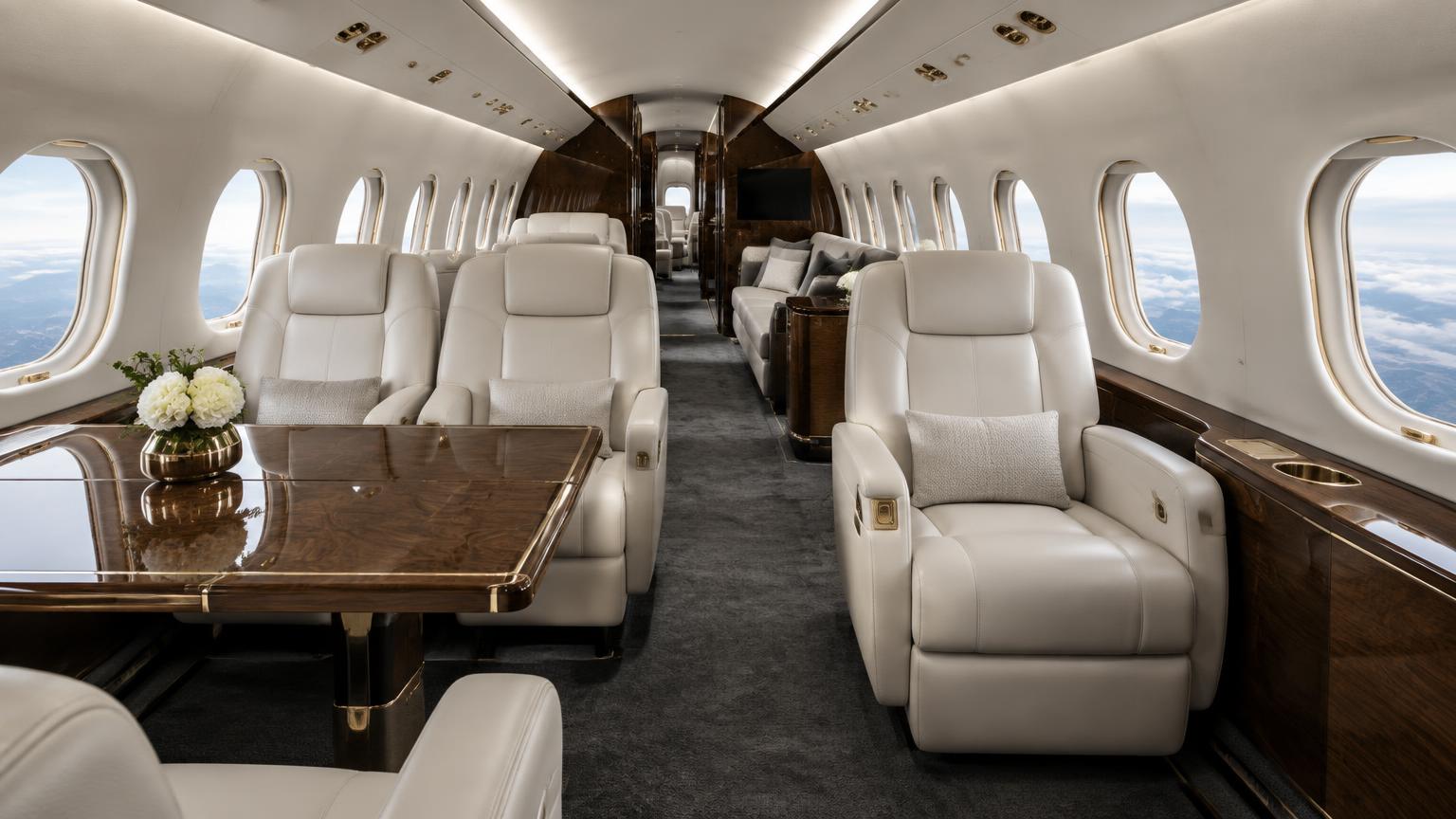
Gulfstream presents the G700 as its largest cabin, with up to five living areas. Whether that matters depends on the mission. For a long overnight sector with several passengers who need separate rest, additional cabin volume and zoning can be meaningful. For a daytime flight with four passengers, the difference may matter far less than the specific layout.
Ask for the actual seating plan, berthing capacity, galley and lavatory configuration of the aircraft being offered.
- How many passengers need a flat bed?
- Is a private suite or separate zone required?
- Which connectivity system is installed and over which regions?
- What is the interior refurbishment date?
Range: published figures are not your mission
Manufacturers publish maximum range under specified assumptions. Your mission’s achievable range depends on passengers and baggage, winds, routing, temperature, alternate airport selection and the operator’s reserve policy. Both types are ultra-long-range aircraft; the practical difference matters only on missions near the limit.
Ask the operator for a flight plan for your city pair on your dates. See range and reserve margins.
Availability and operator
Newer types can be scarcer on the charter market. A well-operated G650 available from a convenient base may serve a mission better than a G700 requiring a long repositioning flight—see repositioning economics.
The operator’s standards, crew and support count at least as much as the type.
Age, refurbishment and the individual airframe
Because the G650 family entered service earlier, available aircraft vary widely in age and interior condition. A recently refurbished G650 may present a fresher cabin than its age suggests; an older interior may show wear. The G700 is newer as a type, but individual configurations still differ.
Ask for the year of manufacture, the date of the most recent interior refurbishment and recent photographs of the actual aircraft. These details often matter more to the experience than the model name.
Connectivity and cabin systems
For many long-range clients, reliable connectivity is a requirement rather than a luxury. Systems installed vary by aircraft, and coverage depends on the provider’s network over your route. Gulfstream describes Ka-band connectivity on the G700; G650-family aircraft may carry different systems depending on factory options and later upgrades.
Ask what is installed on the specific aircraft, what coverage is expected on your route, and whether any data limits or costs apply.
Decision checklist
Use these questions to compare a G650-family offer and a G700 offer on equal terms.
- Is the route near either aircraft’s practical range limit for my load and season?
- How many passengers need flat beds, and does each layout provide them?
- Is a separate zone or suite genuinely required?
- Year of manufacture and last refurbishment of each airframe?
- Connectivity system and expected coverage on my route?
- Where is each aircraft based, and what positioning is included?
- Who is the operator, and how was authority verified?
- Total trip price with matching inclusions?
When the older type is the better choice
There are many missions on which a well-maintained G650-family aircraft from a reputable operator is the more sensible choice: when it is positioned conveniently, when its cabin meets every requirement and when the route sits comfortably within its capability. Choosing newer for its own sake can add positioning cost without changing the journey. See repositioning economics and reading a quote.
Conversely, where cabin zoning for an overnight sector or additional capability margin genuinely changes the mission, the G700 may justify its availability constraints. The decision belongs to the mission.
Common misconceptions
These shortcuts are understandable, because model names are easy to compare and individual airframe details are not. The extra effort of comparing specific aircraft is what turns a reasonable choice into a well-judged one.
- “The newer aircraft is always the better charter choice.” Positioning, configuration and operator often matter more.
- “Maximum range tells me whether my trip is nonstop.” Only the operator’s plan for your load and date can.
- “All G650s are alike.” Airframes differ in age, interior, connectivity and maintenance history.
- “A bigger cabin is always more comfortable.” Layout, berthing and noise matter as much as volume.
How to request comparable offers
Send both operators, or your broker, the same brief: exact airports, date and time, passengers, baggage inventory, rest requirements and connectivity needs. Ask each to confirm nonstop feasibility for that brief, to provide the aircraft registration, year of manufacture and last refurbishment date, and to supply a current cabin layout with berthing count.
When the answers arrive, compare total trip prices with matching inclusions and terms. If the G700 is offered at a premium, ask what specifically it adds to this mission. If the answer is cabin zoning that your passengers will use, or margin on a long winter sector, the premium may be justified. If the answer is mainly that it is newer, the G650-family offer may serve you equally well.
A decision framework
This note deliberately avoids restating specification figures. Manufacturer data reflects stated assumptions; the operator’s flight planning for the actual aircraft, load, route and weather is authoritative.
Choose the G700 where its cabin zoning or capability margin changes the mission. Otherwise compare specific G650-family and G700 offers on configuration, operator, positioning and total price.
Sources & editorial notes
Written by Dr. Christoph Lymbersky as an authored perspective drawing on the public sources below. Sources reviewed 9 October 2026. General editorial guidance, not an individual operating, legal, tax or investment recommendation. Scenarios are labelled illustrative and do not describe real clients. No market-wide prices, statistics or guaranteed aircraft performance are asserted.
- Gulfstream — Aircraft overview ↗
Manufacturer overview of the current-production fleet. The G650 family is no longer in the current-production lineup; data for an individual G650 should come from its operator and flight manual.
- Gulfstream — G700 ↗
Manufacturer page. Published range figures are manufacturer conditions (passengers, crew, reserves, speed), not a guarantee for any individual charter flight.
- eCFR — 14 CFR 135.223, IFR alternate airport requirements ↗
US on-demand operator requirements for fuel to an alternate airport and reserves under instrument flight rules.
- NBAA — Aircraft Charter Consumer Guide ↗
Consumer-oriented guidance on charter quotations, operators and contracts, written primarily from a US perspective.
The illustrations are generated aviation imagery, not evidence of a specific aircraft or operator.
For a live itinerary, see the charter advisory guide or start a private enquiry.