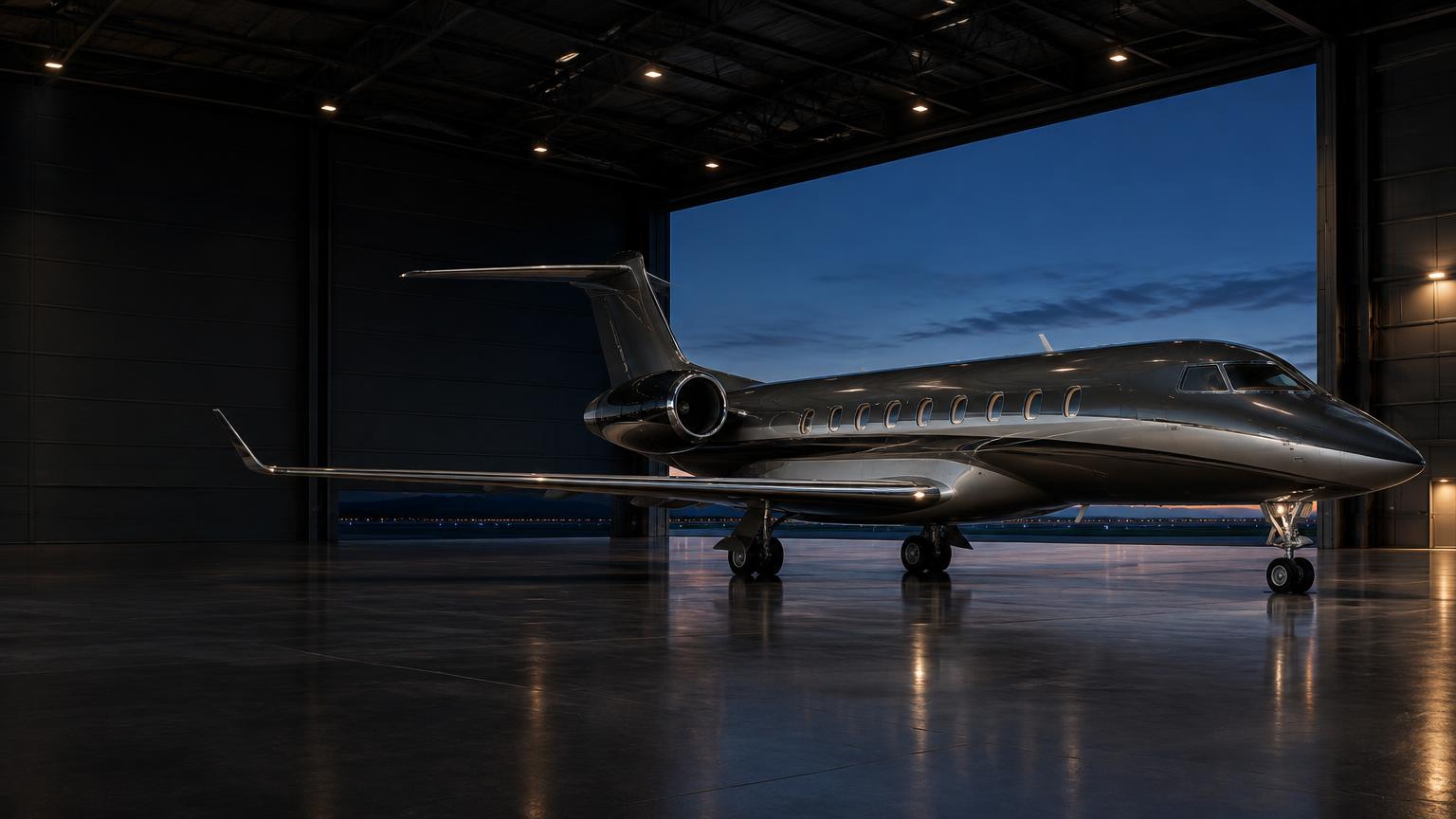
Why the G280 matters now
The G280 was built for Gulfstream by Israel Aerospace Industries and has been delivered since 2012; Duncan Aviation lists its production years as 2012 to the present. Gulfstream celebrated the 300th G280 delivery in June 2025, and three months later announced the G300, which it said will replace the Gulfstream G280. GAMA counted 22 G280 deliveries in 2025 and 13 in the first half of 2026.
The timetable is now firmer. On General Dynamics’ third-quarter call, its president said there will be a gap between the last G280 delivery in mid-2027 and certification of the G300 later that year, with G300 deliveries possible from late 2027 or early 2028, dependent on the situation in the Middle East. Both aircraft are built by IAI in Tel Aviv, where military call-ups have disrupted staffing at the plant. In July, General Dynamics’ chief executive had already described a planned production break between the two.
The cabin, honestly described
GlobalAir’s specification sheet lists the G280 cabin at 25 ft 10 in long, 6 ft 1 in high and 935 cubic feet, with 120 cubic feet of internal baggage and up to 10 passengers. Duncan Aviation’s October 2026 summary gives 7.16 ft of width, 6.25 ft of height and typical seating for eight to ten. Owners can configure it with one or two living areas, and the cabin has 19 large oval windows.
In plain terms: at a little over six feet, most adults stand upright, which is the main step up from a midsize jet. Eight passengers are comfortable on a two-hour sector; for an overnight crossing I plan for four to six, so that some can lie flat. Since 2022 Gulfstream has offered a cabin altitude of 4,800 ft at 41,000 ft, down from 6,000 ft, as a retrofit as well as on new aircraft. That is a real comfort point on a seven-hour flight, but it is an option, so I ask whether the specific aircraft has it.
G280 range: the 3,600 nm figure and the full-cabin reality
Gulfstream has long quoted a 3,600 nm range and a maximum speed of Mach 0.85. Duncan, using Conklin & de Decker data, lists a more cautious NBAA IFR seats-full range of 3,379 nm, a ferry range of 3,722 nm and a normal cruise of 470 knots. For charter planning, the seats-full figure is the one I work from.
The detail that matters most is payload with full tanks. Duncan puts it at 880 lb, and GlobalAir’s sheet at 1,000 lb. Either way, that is four or five people with light bags before the operator has to trade fuel for weight. On a full-range crossing, a full cabin means a shorter leg or a stop. Some great-circle distances, calculated by me, show where the G280 sits:
Flight-plan routes are longer than great circles, and the westbound Atlantic in winter costs real miles. The only number that counts is the operator’s flight plan for that registration, that load and that day; I explain why in realistic range and reserve margins, and the route itself in New York to London by private jet.
- Teterboro–Farnborough: about 2,990 nm. Comfortable on paper, eastbound or westbound in summer.
- Teterboro–Paris Le Bourget: about 3,150 nm. Feasible with a moderate load; winter westbound narrows the margin.
- Teterboro–Frankfurt: about 3,340 nm; Teterboro–Geneva: about 3,350 nm. At the edge of the seats-full figure; I would expect a load or fuel-stop discussion.
- Teterboro–Munich: about 3,500 nm. Beyond the seats-full figure; with a full cabin, plan a stop or a larger aircraft.
- Farnborough–Dubai Al Maktoum: about 2,990 nm. On paper inside the range, with the same payload caveat.
How it compares with the Challenger 350, Praetor 600 and Longitude
Duncan’s October 2026 summary puts the four main super-midsize types on one basis (Duncan Aviation, October 2026):
By my reading of those figures, the G280 has the largest cabin of the four by volume and the highest normal cruise speed, but the smallest payload with full fuel. The Challenger 350 has almost the same cabin volume and a slightly shorter seats-full range, but carries more than twice the payload with full tanks. The Praetor 600 flies furthest with every seat filled. For a European trip of two to four hours the differences are small; on a full-range crossing with eight on board they decide the aircraft.
- Gulfstream G280: seats-full range 3,379 nm; cabin 935 cu ft, 7.16 ft wide, 6.25 ft high; baggage 154 cu ft; payload with max fuel 880 lb; 470 kt.
- Challenger 350: seats-full range 3,277 nm; cabin 930 cu ft, 7.17 ft wide, 6.08 ft high; baggage 106 cu ft; payload with max fuel 1,907 lb; 459 kt.
- Embraer Praetor 600: seats-full range 3,745 nm; cabin 823 cu ft, 6.83 ft wide, 6 ft high; baggage 155 cu ft; payload with max fuel 2,193 lb; 455 kt.
- Citation Longitude: seats-full range 3,365 nm; cabin 755 cu ft, 6.42 ft wide, 6 ft high; baggage 112 cu ft; payload with max fuel 1,589 lb; 469 kt.
What a G280 costs to charter and to run
Jet Supply’s revised Q4 2026 index places the G280 in the super midsize class with the Challenger 350 and Praetor 600, at €6,000 to €9,000 per hour in the air, mid-band €7,500, crew and fuel included, positioning, airport and handling fees and taxes on top. Its route tables give London to Mykonos on a super midsize at typically €37,000 to €52,000 all-in, one way, and London to Dubai at typically €75,000 to €105,000. Within that band, the age of the aircraft, where it is based and whether it must fly home empty move the quote more than the badge.
On the owner’s side, Duncan estimates total variable cost at $5,259 per hour for the G280, $5,421 for the Challenger 350, $5,139 for the Praetor 600 and $5,200 for the Longitude, with fuel at $5.69 a gallon, an average G280 burn of 274 gallons an hour, and major inspections excluded. Those figures are close enough that, for a charter client, they do not decide the choice.
Production ends: what it means for buyers and charter clients
For charter clients, very little changes in the near term. The fleet keeps flying, and it is flown hard: Avi-Go ranked the G280 third among the fastest-growing North American models in January to August 2025, up 12.66% to 29,133 movements, and in June 2026 it was Gulfstream’s most active North American model, with 3,330 flights, 34.07% of the brand. In Europe the picture is different: Avi-Go’s June 2026 Gulfstream mix was led by the G550 with 863 flights and the G650ER with 719. On this side of the Atlantic I compare G280 offers with the Challenger 350 and Praetor 600 as a matter of course.
For buyers, the gap matters more. Duncan’s indicative values run from about $13.0m to $25.0m, depending on year, and GlobalAir noted nine G280s listed on its marketplace in early November. Gulfstream indicated a projected G300 price starting at $28.7 million. My own view, and it is only a view: a well-kept late G280 may hold its value better than older aircraft in the class, because buyers who want a new Gulfstream super midsize before 2028 have only the used market. I set out how used values are formed in used private jet prices.
When I choose a G280
I put a G280 at the top of a shortlist when the trip is four to six passengers over a long sector, the cabin height and windows matter, and the speed helps a schedule. A New York–London eastbound flight, a Gulf return for a small team, or a coast-to-coast trip in the United States suit it well. I look elsewhere when every seat is full on a long leg, where the Praetor 600 or a heavy jet carries the load without a stop, or on a short European hop, where a smaller aircraft does the job for less.
Charter enquiries I take are fulfilled through Limitless Sky. If you send me the trip, I will set a G280 beside a Challenger 350 and a Praetor 600, with the seats-full range, the payload and the all-in price shown for each, so that the choice rests on the mission rather than the badge.
Frequently asked questions
How far can a Gulfstream G280 fly? — Gulfstream quotes 3,600 nm. Duncan Aviation gives 3,379 nm NBAA IFR range with all seats full and 3,722 nm ferry. With a full cabin, a Teterboro–Farnborough crossing of about 2,990 nm is feasible on paper; only the operator’s flight plan on the day confirms a nonstop.
Is the Gulfstream G280 being discontinued? — Yes. Gulfstream expects the final G280 delivery around mid-2027 and certification of its successor, the G300, later in 2027, with G300 deliveries from late 2027 or early 2028. Existing G280s continue to fly and to be offered for charter.
How many passengers does a G280 seat? — Up to 10, with eight to ten typical in Duncan’s data. For long overnight flights I plan for four to six, so that passengers can sleep.
How much does it cost to charter a Gulfstream G280? — Jet Supply’s Q4 2026 index puts the super midsize class, including the G280, at €6,000 to €9,000 per hour in the air in Europe, before positioning, fees and taxes. London to Mykonos typically comes to €37,000 to €52,000 all-in, one way.
Planning a specific journey? Live charter enquiries are handled by Limitless Sky, where the operator, aircraft and terms for your itinerary can be discussed.
Sources & editorial notes
Written by Dr. Christoph Lymbersky as an authored perspective drawing on the public sources below. Sources reviewed 9 November 2026.
General guidance, not individual legal, tax or investment advice. Figures come from the sources below unless marked as my own calculation. Client examples are anonymized.
- Duncan Aviation — Business Jet Model/Market Summary ↗
Vref value ranges and variable cost per hour by model. Values are indicative, not appraisals.
- GlobalAir — Gulfstream G280 specifications and operating cost ↗
Cabin 25 ft 10 in long, 6 ft 1 in high, 7 ft 2 in wide, 935 cu ft; internal baggage 120 cu ft; up to 10 passengers; normal range 3,420 nm, maximum range 3,600 nm; payload with full fuel 1,000 lb; take-off distance 4,750 ft; normal cruise 470 kt.
- Controller — Gulfstream lowers G280’s cabin altitude and raises the business jet’s visibility (11 March 2022) ↗
Cabin altitude lowered from 6,000 to 4,800 ft at 41,000 ft, available new and as a retrofit; 19 large oval windows; certified for steep approaches; 3,600 nm range, Mach 0.85 maximum; entered service 2012.
- Aviation International News — Gulfstream Delivery Ramp Up, G300 EIS Put into Focus (5 November 2026) ↗
General Dynamics: gap between the last G280 delivery in mid-2027 and G300 certification later in 2027; G300 deliveries from late 2027 or early 2028, dependent on the situation in the Middle East; both built by IAI in Tel Aviv, where military call-ups disrupted staffing.
- Corporate Jet Investor — Gulfstream posts strongest order quarter in four years (30 July 2026) ↗
Final G280 expected to deliver in the second quarter of 2027, with the G300 entering production in late 2027 or early 2028 after a planned production break.
- GlobalAir — Gulfstream’s G280 supply narrows as the G300 waits on certification (6 November 2026) ↗
Final G280 deliveries around mid-2027, G300 certification targeted toward late 2027; nine G280s listed on the GlobalAir.com marketplace at publication.
- AOPA — Gulfstream debuts super-midsize G300 (30 September 2025) ↗
Gulfstream celebrated the 300th G280 delivery in June 2025; G300 to carry up to 10 passengers, 3,600 nm at Mach 0.80; projected price starting at $28.7 million.
- Gulfstream via ASDNews — Gulfstream introduces the all-new Gulfstream G300 (30 September 2025) ↗
Gulfstream press release: the super-midsize G300 will replace the G280; 3,600 nm at Mach 0.80 or 3,000 nm at Mach 0.84; cabin altitude 4,800 ft at 41,000 ft; up to 10 passengers.
- GAMA — 2025 Year-End Aircraft Shipments and Billings Report ↗
General Aviation Manufacturers Association delivery data by manufacturer and model for 2025.
- GAMA — 2026 Second Quarter Aircraft Shipments and Billings Report (Gulfstream G280) ↗
Gulfstream G280 deliveries in 2026: 7 in Q1 and 6 in Q2, 13 in the first half.
- Avi-Go — Research & Consulting ↗
Avi-Go periodic market research, including January–August 2025 and 2026 monthly European data.
- Jet Supply — European Private Jet Charter Price Index Q4 2026, revised 1 November 2026 ↗
Revised bands per hour in the air for the whole aircraft, crew and fuel included, positioning, airport and handling fees and taxes excluded: midsize jet (Learjet 60XR, Hawker 900XP) €5,300–€7,000; super midsize jet (Challenger 350, Praetor 600, G280) €6,000–€9,000, mid-band €7,500; super light jet €4,000–€6,000; London–Mykonos (3h 30m, super midsize) flight only from €21,000, typical all-in €37,000–€52,000 one way; not comparable with the Q3 2026 edition.
The illustrations are generated aviation imagery, not evidence of a specific aircraft or operator.
For a live itinerary, see the charter advisory guide or start a private enquiry.