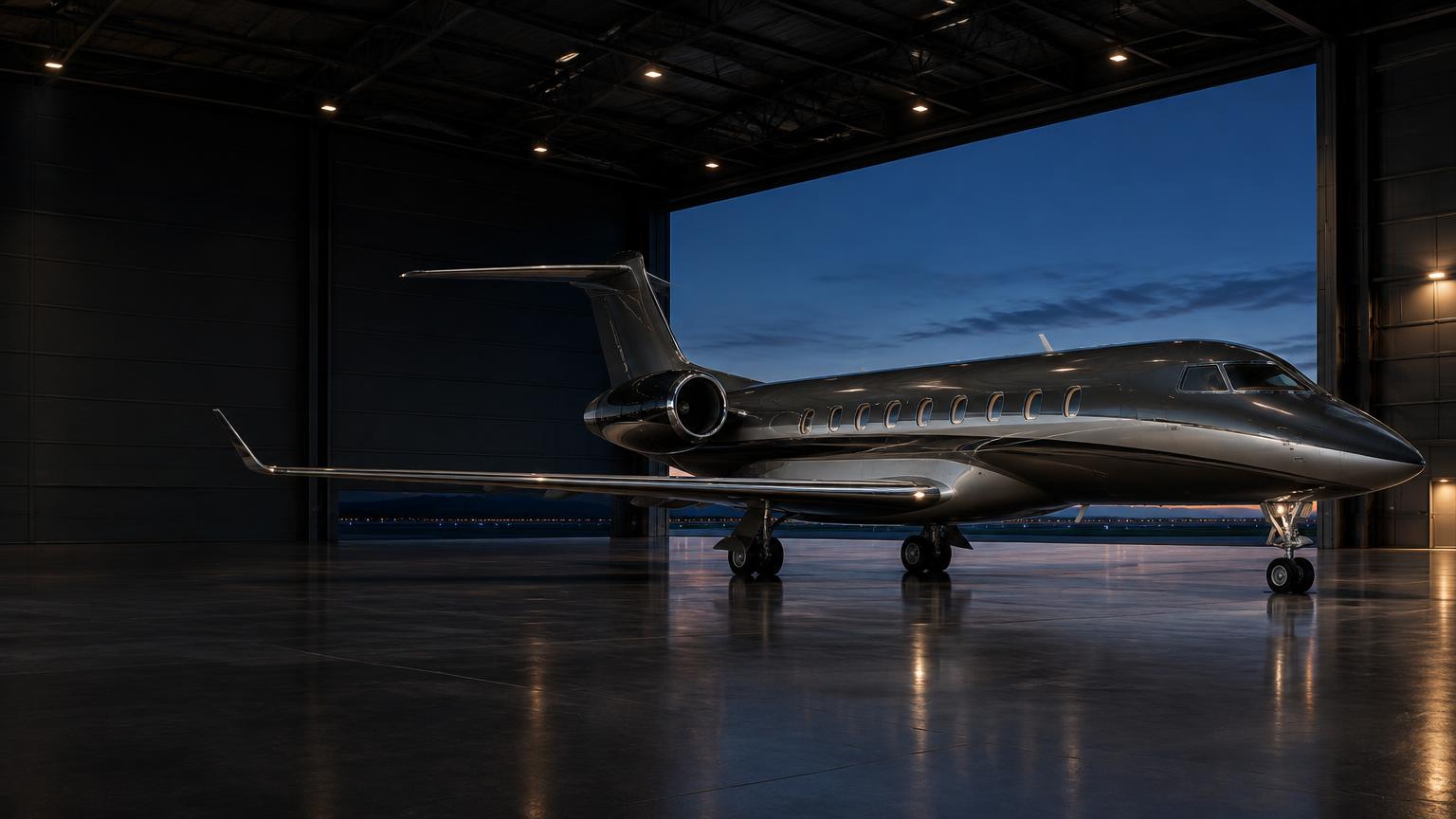
Why the Falcon 2000LXS matters
Dassault puts close to 700 Falcon 2000 series aircraft in service, and calls the LXS the current top of that line. GAMA counted 37 Dassault civil deliveries in 2025 across the 2000LXS, 900LX, 6X and 8X combined, and in the first half of 2026 another 13 deliveries of the 2000LXS, 6X and 8X combined. AvBuyer, citing JETNET, records 142 Falcon 2000LXS units built by July 2024, with production still open.
In Europe the series is a working aeroplane, not a rarity. Avi-Go ranked the Falcon 2000 Series tenth among European models in January–August 2025, with 12,843 movements (3.31%), and on the Geneva–Paris lane it led aircraft share at 13.93% over the same period. In June 2026 the series logged 1,692 flights in Europe, up 26.36% on May. An aircraft that busy on short European sectors and still capable of a North Atlantic nonstop is one I keep on the shortlist.
The cabin: width first
The LXS case begins with the cross-section. Dassault gives the cabin as 74 in (1.88 m) high, 92 in (2.34 m) wide and 26.18 ft (7.98 m) long, with 1,024 cubic feet of cabin volume and 130.6 cubic feet of baggage. Duncan Aviation’s planning summary lists 1,028 cubic feet of cabin, 131 cubic feet of baggage and eight typical seats. Against a Challenger 350’s 930 cubic feet in the same Duncan sheet, that is by my arithmetic about 10% more cabin; against a Citation Latitude’s 587, almost three-quarters more. I set the Challenger out in my Challenger 350 guide; the Citation Latitude, which I covered separately, is the midsize step below.
Dassault seats up to eight to ten passengers. Configurations vary between a double-club and a club-plus-conference layout, so I ask for the seat map of the specific aircraft before I confirm a party of nine or ten.
- Cabin: 7.98 m long, 2.34 m wide, 1.88 m high (Dassault; length excludes flight deck and baggage).
- Seats: up to 8–10 (Dassault); Duncan’s typical figure is eight.
- Baggage: 130.6 cu ft (Dassault); Duncan lists 131 cu ft.
- Speed: Duncan’s normal cruise 453 ktas; Dassault MMO Mach .86.
- Engines and flight deck: two Pratt & Whitney Canada PW308C (7,000 lb), EASy II with Honeywell Primus Epic (Dassault).
Range: the brochure figure and the planning figure
Dassault quotes a 4,000 nm range with eight passengers and NBAA IFR reserves. Duncan’s planning figures are the ones I use for a full cabin: 3,803 nm NBAA IFR range with seats full and 4,151 nm ferry range with no passengers. The aircraft carries a full-fuel payload of 1,840 lb, so with full tanks you are still trading bags and people against fuel, but with more margin than most of the class below.
On great-circle distances, by my arithmetic and before winds and routing: London to New York is about 3,000 nm and Paris to New York about 3,150 nm, both inside the seats-full figure; Geneva to New York about 3,350 nm, still inside it; London to Dubai about 2,970 nm and Munich to Dubai about 2,470 nm, comfortably so. The brochure 4,000 nm is a light-cabin figure; for a full cabin I plan on Duncan’s 3,803 nm, and I still ask the operator for the day’s flight plan. Why a published range is not a planning figure is in realistic range and reserve margins.
Short fields: the LXS argument
Dassault gives a take-off distance of 4,675 ft (1,425 m) at maximum take-off weight and a landing distance of 2,260 ft (689 m) at typical landing weight, with a Vref of 105 kias. The short landing figure is the one clients notice: it is turboprop territory on paper, and it is why the LXS is often the first large-cabin jet I consider for London City, Lugano or a steep Alpine approach when the operator will accept the airfield.
The LXS took the long-range wing of the Falcon 2000LX and the full-span leading-edge slats of the shorter-legged 2000S. Duncan’s seats-full ranges for the family make the trade clear: the original Falcon 2000 at 2,841 nm, the 2000S at 3,371 nm, the 2000LX at 3,891 nm and the LXS at 3,803 nm. A few dozen miles of seats-full range were given up for airfield access. A field-length figure is still a certification number at stated conditions; on a hot or contaminated runway the operator’s performance calculation for that aircraft decides, and I ask for it before I confirm the trip.
What it costs to run and to charter
Duncan Aviation estimates the LXS’s total variable cost at $5,826 per hour, against $5,421 for the Challenger 350 and $5,139 for the Praetor 600 in the same summary. By my arithmetic it runs about 7% dearer per hour than a Challenger 350. Its average fuel burn is 270 gallons per hour, below the Challenger 350’s 280. Using the EU’s emission factor, as I explained in private jet emissions, that is by my arithmetic about 2.6 tonnes of CO2 per hour.
On charter, Jet Supply’s revised Q4 2026 index does not name the Falcon 2000LXS. Its super-midsize band, led by the Challenger 350, Praetor 600 and G280, runs €6,000 to €9,000 per hour in the air, and its heavy-jet band, which lists the Falcon 900 beside the Challenger 650 and G450, €8,100 to €12,000, both before positioning, fees and taxes. I treat the LXS as sitting between those bands depending on the operator and the cabin, and I ask which band a quote is built on. For a sense of a whole trip: Jet Supply puts London to Mykonos in a super-midsize at €37,000 to €52,000 one way, all-in. Where the LXS sits relative to the class below is also in midsize versus super-midsize jets and in my Praetor 600 guide.
Buying one: thin stock, firm values
Duncan Aviation’s summary puts LXS values, built from 2013 to the present, at $17.741m to $39.066m, indicative rather than an appraisal. The pre-owned market is tight. Holstein Aviation’s recent snapshot puts inventory down about 50% year on year, with pricing up roughly 36%, 20 retail sales over twelve months and about 3.2 months of inventory. Jones Aviation, in a February 2026 market note, counted five Falcon 2000LXS publicly listed, 3.2% of the active LXS fleet, and put typical LXS values in the mid-$20m range.
On a used aircraft I check inspection status first. Holstein notes that airframes with recent major C checks sell at a premium, and that landing-gear overhaul backlogs and corrosion findings still move the price. Connectivity and programme enrolment (FalconCare, engine programmes) are the next items on my list; an LXS without current global connectivity will compete on price with one that has it. For the wider used market I keep a separate note on used private jet prices by model.
When I choose it, and when I do not
I choose the Falcon 2000LXS for six to ten passengers on sectors of four to eight hours, where the wide cabin and the short-field manners matter: London or Geneva to the US East Coast, a European city-pair into London City or Lugano, or a winter trip to Dubai with a full cabin and bags. I look elsewhere when the mission is a two-hour European hop for four, where a Challenger 350 or Praetor 600 does the same job for less, or when the client needs a true ultra-long-range cabin and a three-engine Falcon or a Global is the honest answer.
Charter enquiries I take are fulfilled through Limitless Sky. If you send me the trip, I will put an LXS next to the aircraft either side of it, with the seats-full range, the hold and the all-in price set out, so that the choice rests on the mission rather than the label.
Frequently asked questions
How far can a Falcon 2000LXS fly? — Dassault quotes 4,000 nm with eight passengers and NBAA IFR reserves. Duncan Aviation gives 3,803 nm NBAA IFR range with all seats full, and 4,151 nm ferry. From London that reaches New York on paper with a full cabin; only the operator’s flight plan on the day confirms a nonstop.
Is the Falcon 2000LXS a super-midsize or a heavy jet? — Manufacturers and brokers disagree. Its cabin width and volume sit with the large-cabin jets; Jet Supply’s heavy band lists the related Falcon 900. Duncan groups it with large jets by seats-full range. I compare it with both the Challenger 350 / Praetor 600 step and the heavy band above.
How many passengers does a Falcon 2000LXS seat? — Dassault says up to eight to ten. Duncan’s typical figure is eight. Configurations vary, so ask for the seat map of the specific aircraft.
How much does a used Falcon 2000LXS cost? — Duncan Aviation’s indicative values run from about $17.7m to $39.1m depending on year. Jones Aviation put typical LXS values in the mid-$20m range in early 2026, with only about 3% of the active fleet listed.
Planning a specific journey? Live charter enquiries are handled by Limitless Sky, where the operator, aircraft and terms for your itinerary can be discussed.
Sources & editorial notes
Written by Dr. Christoph Lymbersky as an authored perspective drawing on the public sources below. Sources reviewed 6 November 2026.
General guidance, not individual legal, tax or investment advice. Figures come from the sources below unless marked as my own calculation. Client examples are anonymized.
- Dassault Falcon — Falcon 2000LXS overview and specifications ↗
Manufacturer data: range 4,000 nm with 8 passengers (NBAA IFR reserves); up to 8–10 passengers; MMO Mach .86; maximum certified altitude 47,000 ft; take-off distance 4,675 ft (1,425 m) at MTOW, sea level ISA; landing distance 2,260 ft (689 m) unfactored at typical landing weight; approach speed Vref 105 kias; cabin 74 in (1.88 m) high, 92 in (2.34 m) wide, 26.18 ft (7.98 m) long, volume 1,024 ft³; baggage 130.6 ft³; engines two Pratt & Whitney Canada PW308C at 7,000 lb thrust; EASy II flight deck with Honeywell Primus Epic; close to 700 Falcon 2000 series aircraft in service. Not a guarantee for any individual charter flight.
- AvBuyer — Dassault Falcon 2000LXS jets for sale (JETNET production count, accessed 6 November 2026) ↗
JETNET via AvBuyer: production started in 2013 and continues, with 142 Falcon 2000LXS units built by July 2024; typically configured for eight to ten passengers; Conklin & de Decker maximum range cited as 4,151 nm with four passengers.
- Holstein Aviation — Falcon 2000LXS market snapshot (library page, accessed 6 November 2026) ↗
Used-market snapshot: over the past 12 months inventory down approximately 50% and pricing up roughly 36% year on year; 20 retail sales in 12 months; six sold in December with two more since the start of 2026; vintages sold since December from 2013 to 2025; about 3.2 months of inventory; market described as active and strengthening with firm pricing and constrained inventory.
- Jones Aviation Group — Market Mondays: Dassault Falcon 2000LXS (LinkedIn, February 2026) ↗
Five Falcon 2000LXS aircraft publicly listed for sale, representing 3.2% of the active LXS fleet; Falcon 2000 programme has delivered over 675 aircraft since introduction; true Falcon 2000LXS values typically in the mid-$20m range; early Falcon 2000EX EASy commonly trading in the $9m–$10m range.
- GAMA — 2026 Second Quarter Aircraft Shipments and Billings Report ↗
Dassault Aviation reported 13 combined civil airplane deliveries of the 2000LXS / 6X / 8X in the first half of 2026 (semi-annual reporting), with estimated billings $760.4 million. Dassault reports combined civil deliveries twice a year.
- Duncan Aviation — Business Jet Model/Market Summary ↗
Vref value ranges and variable cost per hour by model. Values are indicative, not appraisals.
- Avi-Go — Research & Consulting ↗
Avi-Go periodic market research, including January–August 2025 and 2026 monthly European data.
- GAMA — 2025 Year-End Aircraft Shipments and Billings Report ↗
General Aviation Manufacturers Association delivery data by manufacturer and model for 2025.
- Jet Supply — European Private Jet Charter Price Index Q4 2026, revised 1 November 2026 ↗
Revised bands per hour in the air for the whole aircraft, crew and fuel included, positioning, airport and handling fees and taxes excluded: midsize jet (Learjet 60XR, Hawker 900XP) €5,300–€7,000; super midsize jet (Challenger 350, Praetor 600, G280) €6,000–€9,000, mid-band €7,500; super light jet €4,000–€6,000; London–Mykonos (3h 30m, super midsize) flight only from €21,000, typical all-in €37,000–€52,000 one way; not comparable with the Q3 2026 edition.
The illustrations are generated aviation imagery, not evidence of a specific aircraft or operator.
For a live itinerary, see the charter advisory guide or start a private enquiry.