Dubai’s winter season, and this year’s caveat
Dubai entered 2026 at a record. The aerospace hub at Al Maktoum International logged 20,289 business aviation movements in 2025, up 17%, with more than 6,926 in the fourth quarter alone. Then came the strikes on Iran of 28 February. WingX data reported by AIN show business aviation in the Gulf states falling by as much as 69% between late March and early May, recovering, then falling again by 30% in August.
The recovery is under way but incomplete. In the week to 24 October, WingX counted 1,536 business jet departures in the Middle East, 14% up on the week but 11% down on a year earlier. The season’s fixed points remain: the MEBAA Show runs from 8 to 10 December 2026 at Dubai World Central. For a client, that means aircraft and handling are available, but the planning around the flight carries more weight than in a normal winter.
Al Maktoum (DWC) or Dubai International (DXB)?
Dubai has two airports, and for a private jet the default is now Al Maktoum, also called Dubai World Central. Dubai International remains open to business aviation, but on its own terms. It is a Level 3 coordinated airport: every flight needs DCAA landing permission and an ACL slot, and general aviation is barred from whole blocks of the day. In local time, that is no arrivals from 04:30 to 06:29 or from 23:00 to 01:29, no movements at all from 14:30 to 18:29 except on Mondays, and no departures from 07:30 to 11:59 or from 03:00 to 04:59, by my conversion of the published UTC times. A larger jet staying more than 24 hours must be towed to its FBO’s apron or relocated to DWC.
The industry has moved accordingly. ExecuJet told AIN that the business aviation split between the two airports has gone from 60-40 to approaching 80-20 in Al Maktoum’s favour, which it attributes to slot competition at DXB. Al Maktoum has depth: in June 2026, Avi-Go counted 163 origin cities and 225 different aircraft there. Jetex, ExecuJet, DC Aviation Al Futtaim and Falcon Aviation all operate on the field; Jetex alone handled almost 75% of the airport’s business aviation movements in 2022. I use DXB only when a downtown meeting makes the drive matter and a slot fits the schedule; otherwise I plan Al Maktoum.
The airspace in November 2026
Dubai is open; the shortest route to it is not. EASA’s conflict zone bulletin for the Gulf, valid until 16 November 2026, tells operators not to fly over the waters of the Persian Gulf within the Bahrain, Kuwait, Doha and Emirates FIRs, except as necessary for arrivals and departures, and to avoid the Gulf of Oman west of 58°E. OPSGROUP’s October summary adds that Iran and Iraq remain avoid at all altitudes under EASA advice, so most Europe–Gulf traffic takes the southern bypass via Egypt and Saudi Arabia, where it reports heavy congestion in the Jeddah FIR and widespread GPS jamming around Gulf airports.
Two further costs follow. AviNews reports that insurers are watching war-risk premiums closely, while cover for flights into the major Gulf hubs remains available, and the advisories bring extra contingency fuel and longer flight times. The bulletins are reviewed at short intervals, so anything I write here can change within days. Before I confirm a Dubai trip, I ask the operator for the planned routing, the FIRs on it, its own risk assessment and the war-risk wording on its insurance. An operator who cannot show those is not one I would book; I set out the wider checks in private jet safety ratings.
Distance: the map line and the flown line
By my arithmetic, great-circle distances to Al Maktoum are about 2,980 nm from Farnborough, 2,840 nm from Paris–Le Bourget, 2,660 nm from Geneva, 2,650 nm from Hamburg and 2,470 nm from Munich. A dog-leg via Cairo, roughly the shape of the southern bypass, makes them longer: about 3,210 nm from Farnborough, 2,830 nm from Geneva, 2,990 nm from Hamburg and 2,720 nm from Munich, between 6% and 13% more. These are illustrations, not filed routes; the operator’s flight plan on the day decides.
Set those against Duncan Aviation’s seats-full NBAA IFR ranges and the aircraft choice becomes clearer. The Citation Latitude, at 2,455 nm, needs a stop from all of these cities on the detour. The Challenger 350, at 3,277 nm, covers Geneva, Munich and Hamburg on paper, but from London it is within about 65 nm of its figure before winds, which I would not plan as a nonstop in winter. The Praetor 600 (3,745 nm) and Challenger 650 (3,756 nm) carry a real margin from all of them, and the Falcon 900LX (4,800 nm) more still. Why a published range is not a planning figure is in realistic range and reserve margins.
- Farnborough–Dubai (DWC): about 2,980 nm direct, about 3,210 nm via Cairo.
- Paris–Le Bourget–Dubai: about 2,840 nm direct, about 3,040 nm via Cairo.
- Geneva–Dubai: about 2,660 nm direct, about 2,830 nm via Cairo.
- Hamburg–Dubai: about 2,650 nm direct, about 2,990 nm via Cairo.
- Munich–Dubai: about 2,470 nm direct, about 2,720 nm via Cairo.
Which aircraft I would quote
For four to six passengers from Geneva, Munich or Hamburg, a Challenger 350 is the natural starting point, and I compare it in detail in my Challenger 350 guide. From London, or with a full cabin and winter bags, I quote a Praetor 600 or a heavy jet alongside it, because the extra range turns a planned fuel stop into a nonstop with reserves. The Praetor 600 is often the best value at that step.
A one-stop trip in a smaller jet is not a failure. A fuel stop adds time on the ground but can bring the price down, and on a route with changing advisories a planned stop is better than an unplanned one. What I avoid is a quote that shows a nonstop the aircraft can only make in perfect conditions.
What a private jet to Dubai costs
Jet Supply’s revised Q4 2026 index puts London to Dubai on a super midsize at a typical 8 hours 25 minutes, flight-only from €50,500 and typically €75,000 to €105,000 all-in, one way. Its hourly bands for the larger classes are €8,100 to €12,000 for a heavy jet and €9,900 to €17,000 for ultra-long-range, before positioning, fees and taxes. On long-haul, Jet Supply notes that positioning adds about half again to the flying, and that a return trip or an empty leg takes most of it out.
Three items move a Dubai quote this winter beyond the usual ones: the longer routing, the extra contingency fuel and the war-risk premium. I ask for each to be shown, so that two quotes can be compared on the same basis; the method is in charter repositioning economics. If the client is staying for a week, I compare a return with the aircraft waiting against two one-ways, because on this distance the empty sectors are a large part of the bill.
Paperwork and arrival
Both airports need permission in advance. At Al Maktoum, the operator needs DCAA landing permit approval and an ACL slot, and requests are processed by the operator’s appointed FBO, which also confirms handling and parking. In practice the operator and its handler arrange this, but I check it is confirmed before the client leaves home, not on the way.
For passengers, the UAE government advises that passports must be valid for at least six months from the date of entry, and that some nationalities can obtain a visa on arrival while others must apply in advance. I ask for passport details early, so that the operator and FBO can check each traveller, not just the lead passenger.
How I plan a Dubai trip
I start with the passengers, the bags and the departure city, then ask the operator for the routing it would fly that week, not the great-circle line. From there I pick the aircraft that makes the routed distance with reserves, choose Al Maktoum unless DXB adds something real, and set out the price with routing, fuel and insurance items visible. I recheck the advisories 48 hours before departure.
Charter enquiries I take are fulfilled through Limitless Sky. If you send me your dates and party, I will set out the realistic route, one nonstop and one one-stop option, and the all-in price for each.
Frequently asked questions
Which airport do private jets use in Dubai? — Mostly Al Maktoum International (DWC), where the business aviation FBOs are concentrated. Dubai International (DXB) accepts private flights, but with a slot, DCAA permission and daily periods when business aviation cannot arrive or depart.
How long is a private jet flight from London to Dubai? — Jet Supply’s index gives a typical 8 hours 25 minutes on a super midsize. With the current southern routing, the flown distance from London is by my arithmetic about 3,200 nm, so allow for a fuel stop in smaller jets.
How much does a private jet to Dubai cost? — Jet Supply puts London to Dubai on a super midsize at typically €75,000 to €105,000 all-in, one way. Heavy and ultra-long-range jets cost more per hour; a return trip or an empty leg can lower the cost per sector.
Can I fly privately to Dubai now? — Yes. As of 5 November 2026 Dubai’s airports are open. EASA advises European operators to avoid the airspace over the Gulf waters except for arrivals and departures, and to avoid Iran and Iraq, so routes are longer. The advice is reviewed often; check it, and the operator’s risk assessment, before you fly.
Planning a specific journey? Live charter enquiries are handled by Limitless Sky, where the operator, aircraft and terms for your itinerary can be discussed.
Sources & editorial notes
Written by Dr. Christoph Lymbersky as an authored perspective drawing on the public sources below. Sources reviewed 5 November 2026.
General guidance, not individual legal, tax or investment advice. Figures come from the sources below unless marked as my own calculation. Client examples are anonymized.
- Emirates News Agency (WAM) — Dubai South achieves 17% growth in business aviation movements in 2025 (11 February 2026) ↗
Mohammed Bin Rashid Aerospace Hub at Dubai South (Al Maktoum International, DWC) recorded 20,289 business aviation movements in 2025, up 17% on 2024 and the highest private jet activity recorded in Dubai; more than 6,926 movements in Q4 2025, up 18% year on year.
- Aviation International News — Iran War Continues To Weigh on Gulf Business Jet Traffic (7 October 2026) ↗
WingX data: business aviation flying in the six GCC states fell by as much as 69% between late March and early May 2026, after the strikes on Iran of 28 February; traffic recovered some ground, then fell again by 30% in August; in September Riyadh (OERK) movements fell 32% while Jeddah rose 90% and Dammam 71%.
- Private Jet Card Comparisons — Private Jet Flight Activity Analysis, 2026 Week 43 (WingX data, 29 October 2026) ↗
Week 43 (ended 24 October 2026): Middle East 1,536 business jet departures, 14% up on the prior week and 11% down year on year; last four weeks 5,874 departures, 12% down year on year. Europe 10,767 departures, 2% down year on year. Includes jets and VIP airliners.
- MEBAA — MEBAA Show 2026 ↗
MEBAA Show 2026 takes place from 8 to 10 December 2026 at the Dubai Airshow site, Dubai World Central (DWC).
- Dubai Airports — Conditions of Use, DXB General Aviation (NS26) ↗
DXB is a Level 3 coordinated airport; no general aviation operator may operate without DCAA landing permission and an ACL slot. GA may not be scheduled or operated: arrivals 0030–0229 and 1900–2129 UTC; arrivals and departures 1030–1429 UTC (not on Mondays); departures 0330–0759 and 2300–0059 UTC (8.5 and 10.5 hours of restrictions). Code C–F aircraft on the ground more than 24 hours must be towed to the FBO apron or relocated to DWC.
- Dubai Airports — Conditions of Use, DWC General Aviation (NS26) ↗
At Al Maktoum International (DWC) no GA operator may operate without DCAA landing permit approval and an ACL slot; landing permission requests are made through the DCAA online portal; GA movement requests are processed by the operator’s appointed FBO, which also confirms handling and parking.
- Aviation International News — FBO Profile: ExecuJet Middle East Reaps Rewards of Patient Strategy (November 2026) ↗
ExecuJet FBO at Al Maktoum (OMDW) opened formally at the end of 2024, 15,000 m² including a 7,000 m² hangar; Jetex held almost 75% of OMDW movements in 2022; other FBOs on the field include DC Aviation Al Futtaim and Falcon Aviation; ExecuJet says the business aviation split between DXB and DWC has moved from 60-40 to approaching 80-20 in DWC’s favour because of slot competition at DXB; ExecuJet says it handles about 40% of total business jet movements into Dubai.
- EASA — Conflict Zone Information Bulletin CZIB-2026-07R3: Airspace of the Persian Gulf and Gulf of Oman ↗
Issued 14 July 2026, validity extended on 30 September 2026 to 16 November 2026. Recommends not operating over the waters of the Persian Gulf within the Bahrain, Kuwait, Doha and Emirates FIRs except as necessary for arrivals and departures, nor over the Gulf of Oman west of 58°E in the Muscat FIR; caution over land; up-to-date risk assessment and contingency planning required.
- OPSGROUP — Middle East Airspace: Current Operational Picture (19 October 2026 update) ↗
Iran and Iraq remain avoid-at-all-altitudes under EASA CZIBs extended to 16 November; EASA advises avoiding two areas of the Jeddah FIR; most operators route Europe–Gulf via the southern bypass over Egypt and Saudi Arabia, with heavy ATC congestion reported in the Jeddah FIR; the central route via Iraq and Kuwait is not available to operators following EASA advice on Iraq; widespread GPS jamming and spoofing reported around Gulf airports including OMDW and OMDB.
- AviNews (Avi-Go) — EASA Extends Conflict Zone Bulletin to 16 November 2026 as UAE and Gulf Hubs Remain Open (28 October 2026) ↗
Hubs in Abu Dhabi, Dubai and Sharjah remain open; the advisory brings tactical rerouting, extra contingency fuel and longer flight times; insurers maintain heightened vigilance on war-risk premiums while cover for flights into major Gulf hubs remains available; the next review is on 16 November 2026.
- The Official Portal of the UAE Government — Check if you need a visa to enter the UAE (updated 13 July 2026) ↗
GCC citizens need no visa; some nationalities can obtain a visa on arrival, others must apply in advance; passports must be valid for at least six months from the date of entry; the eligible list may change, so check with the UAE embassy before travelling.
- Avi-Go — Research & Consulting ↗
Avi-Go periodic market research, including January–August 2025 and 2026 monthly European data.
- Duncan Aviation — Business Jet Model/Market Summary ↗
Vref value ranges and variable cost per hour by model. Values are indicative, not appraisals.
- Jet Supply — European Private Jet Charter Price Index Q4 2026, revised 1 November 2026 ↗
Revised bands per hour in the air for the whole aircraft, crew and fuel included, positioning, airport and handling fees and taxes excluded: midsize jet (Learjet 60XR, Hawker 900XP) €5,300–€7,000; super midsize jet (Challenger 350, Praetor 600, G280) €6,000–€9,000, mid-band €7,500; super light jet €4,000–€6,000; London–Mykonos (3h 30m, super midsize) flight only from €21,000, typical all-in €37,000–€52,000 one way; not comparable with the Q3 2026 edition.
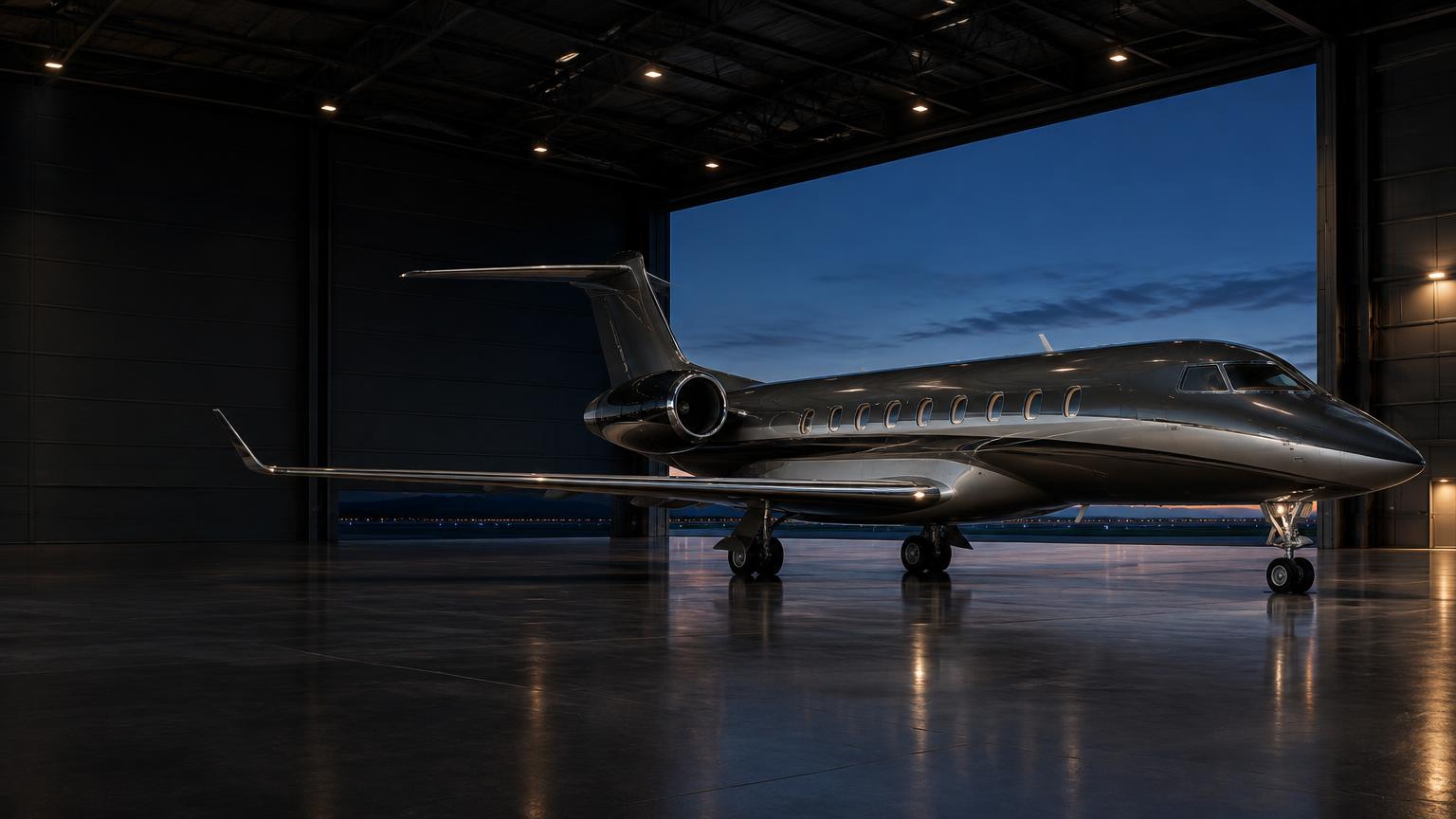
The illustrations are generated aviation imagery, not evidence of a specific aircraft or operator.
For a live itinerary, see the charter advisory guide or start a private enquiry.