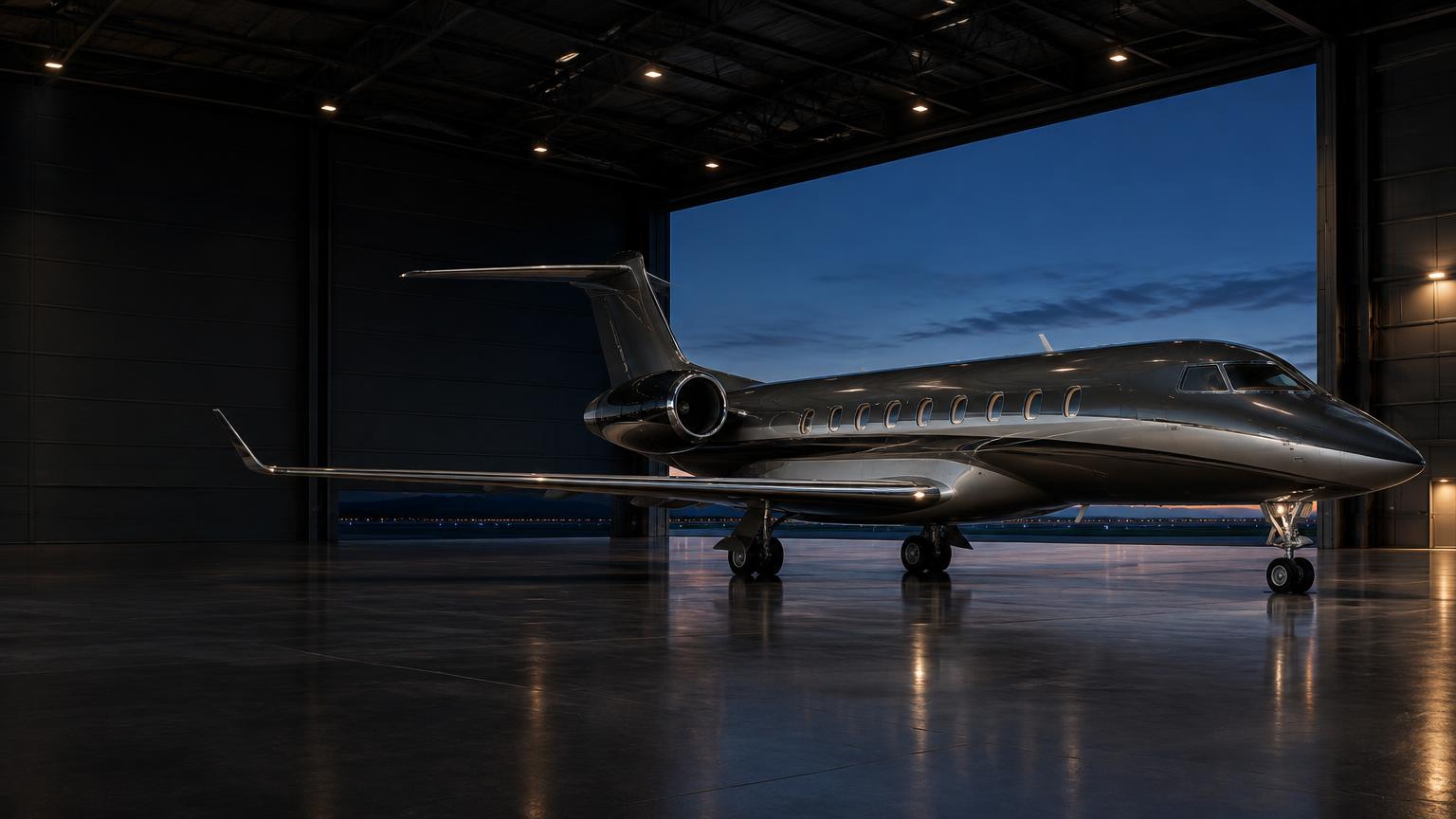
What the G550 is
The G550 is a large-cabin, long-range twinjet built in Savannah, Georgia. Its certification name is the GV-SP, an improved Gulfstream V; the FAA data sheet records the GV-SP as approved on 14 August 2003, with two BMW-Rolls-Royce Deutschland BR700-710C4-11 engines, and the EASA data sheet gives the EASA/JAA certification date as 9 March 2004, with a maximum take-off weight of 41,277 kg (91,000 lb) and a maximum seating capacity of nineteen.
Production has ended. AIN reported that Gulfstream delivered the final commercial G550 on 30 June 2021, after more than 600 had been built since certification in August 2003. By my arithmetic, that makes the youngest commercial G550s about five years old and the oldest more than twenty. On the charter market you will meet both, and they are not the same product.
Range: what 6,750 nm means with a full cabin
Gulfstream’s specification sheet gives the G550 a maximum range of 6,750 nm at Mach 0.80, with eight passengers, four crew and NBAA IFR reserves. Duncan Aviation’s October 2026 model summary, built on Conklin & de Decker and Vref data, gives 6,583 nm with every seat full and 6,954 nm on a ferry flight with no passengers. One detail surprised me: in the same table, the newer Gulfstream G600 shows 6,439 nm seats-full, slightly less than the G550. Range is not the reason to pay for the newer aircraft.
By my great-circle arithmetic, with no winds, routing or alternates, these sectors sit inside the 6,583 nm seats-full figure:
- Frankfurt to Teterboro: about 3,343 nm. Munich to Teterboro: about 3,502 nm.
- Frankfurt to Los Angeles: about 5,033 nm. Hamburg to Los Angeles: about 4,906 nm.
- Frankfurt or Munich to Tokyo Haneda: about 5,055 nm.
- Munich to Singapore: about 5,430 nm. Frankfurt to Singapore: about 5,550 nm.
- Farnborough to Hong Kong: about 5,217 nm. Farnborough to Singapore: about 5,890 nm.
- Frankfurt to Buenos Aires: about 6,211 nm, inside on paper but with little margin; I would not promise it non-stop without the operator’s fuel plan for the day.
Payload: the trade-off behind the range
The range comes from fuel, and fuel takes weight. Gulfstream gives a maximum payload of 6,200 lb, but 1,800 lb (816 kg) with full fuel; Duncan’s table gives 2,300 lb with full fuel, the difference reflecting the outfitting each assumes. At 100 kg per passenger with luggage, my own rule of thumb, 816 kg is about eight people. So the brochure range and a full cabin do not come together: on the longest sectors, the operator trades seats or bags for fuel.
On a seven- or eight-hour sector with eight or more passengers, I ask the operator for a fuel plan at the real load, with the real bags, before I confirm a non-stop. I explain why the brochure line is not a flight plan in my note on realistic range and reserve margins.
The cabin you actually sit in
The specification sheet gives a finished cabin 6 ft (1.83 m) high and 7 ft (2.13 m) wide, 43 ft 11 in (13.39 m) long excluding baggage and 50 ft 1 in (15.27 m) in total, with a cabin volume of 1,669 cu ft. It lists 14 oval windows, seating for up to 19 and sleeping for up to 8, and a baggage compartment of 170 cu ft; the EASA data sheet sets the cargo compartment limit at 1,134 kg (2,500 lb).
That is a true long-range cabin, with room for several people to sleep on a night crossing. It is not the widest in its class. Duncan’s figures give the G550 a cabin width of 7.3 ft against 7.9 ft for the Global 6000; I compare the two in my note on the Global 6000. For eight people overnight, the difference is felt in the aisle, not in the beds.
On a type built over eighteen years, two aircraft with the same name can feel a decade apart. I always ask for the seating plan, the year of the last interior refurbishment and the connectivity actually installed.
Runways and airports
Gulfstream gives a take-off distance of 5,910 ft (1,801 m) at sea level, ISA and maximum take-off weight, and a wingspan of 93 ft 6 in (28.50 m) and a length of 96 ft 5 in (29.39 m). The runway figure is for a full aircraft on a standard day; most European sectors fly well below maximum weight, but at hot or high airports the operator’s performance calculation decides.
The dimensions matter more often than the runway. At Aspen, the 95 ft wingspan limit leaves the G550 just inside, which I set out in my Aspen note. In Palma, an aircraft longer than 20 m falls under the summer seven-day parking limit, and at Ibiza the summer stand rules start at an 18 m wingspan; the G550 is over both lines, as I explain in my Mallorca note.
What it costs to charter in Europe
Jet Supply’s European index, revised on 1 November 2026, does not name the G550. It puts heavy jets, a class in which it lists the Challenger 650, Falcon 900 and Gulfstream G450, at €8,100 to €12,000 per hour in the air, and ultra-long-range jets, the Global 7500, Gulfstream G650 and Falcon 8X, at €9,900 to €17,000. Crew and fuel are included; positioning, airport and handling fees and taxes are not.
The G550 sits between those two bands: it has the range of the second and the age of the first, and I compare its quotes against both. For a transatlantic benchmark, the same index gives New York to London on a heavy jet, 6 hours 35 minutes, from €53,400 flight only and €79,000 to €112,000 all-in, one way. That route is the G550’s natural territory.
What moves a G550 price most is where the aircraft is. Because so many are in service, there is often one within reach of a European departure; a quote that includes a long empty positioning flight should be compared with one that does not.
What it costs to run
Duncan estimates the G550’s total variable cost at $8,482 per hour, at a fuel price of $5.69 per gallon and excluding major inspections, with an average fuel burn of 431 gallons per hour. By my arithmetic, fuel alone is about $2,450 of that hour. For comparison, the same table gives the G450 $7,912, the G600 $8,449 and the Global 6000 $9,671 per hour.
These are the costs of the aircraft in the air, not the charter price, and they exclude crew salaries, hangar, insurance and the large scheduled inspections that weigh heavily on an older long-range jet.
What a used G550 is worth
Duncan’s October 2026 Vref marketing values for the G550 run from $11.423 million to $31.630 million. For context, the same table gives $8.059 million to $16.729 million for the G450, $12.931 million to $43.698 million for the Falcon 7X and $43.563 million to $58.344 million for the G600.
The spread is year of build, hours, cycles and, above all, maintenance status. On a G550 I look first at when the next major inspections fall due, whether the engines are enrolled on a maintenance programme, and what avionics and connectivity upgrades have been made. The model name is not a price; the tail number is. I set out how I read used values in my note on used private jet prices.
The G500 name trap
One detail catches out buyers and charter clients alike. The FAA data sheet lists two variants of the GV-SP: the G550, and a G500 with reduced fuel capacity, with 41,300 lb of usable fuel against 35,200 lb. Gulfstream later reused the name: Duncan lists a Gulfstream G500 with Pratt & Whitney engines, produced from 2018, a different and much newer aircraft.
So a “G500” on a quote or a listing can be an early-2000s sister of the G550 with less fuel, or a recent aircraft from the current family. I ask for the serial number: the data sheet gives the GV-SP serials from 5001 upwards, and the serial tells you which aircraft you are actually being offered.
How much the type still flies
Avi-Go’s 2025 annual report named the G550 the most-flown ultra-long-range jet of 2025, with 59,708 departures and 15.88% of ultra-long-range flying. In Europe it led Gulfstream’s June 2026 mix with 863 flights, 39.23% of the brand’s European flying.
Those numbers explain why it keeps appearing on my quotes. A fleet that busy is also, in my reading, one where crews and maintenance support are easier to find than for a rare type, which matters for an aircraft no longer in production.
My view, briefly
I use the G550 for eight to fourteen passengers on long sectors: Germany to the US East Coast, Europe to the Gulf, Asia or the US West Coast, and night crossings where people need to sleep. I would choose a newer aircraft when the client wants the latest cabin, wider seats or the newest connectivity, and a super-midsize jet when four people fly two hours within Europe.
A well-kept G550 remains one of the most sensible ways to cross an ocean privately. Judge it by the tail number, the interior date and the operator, not by the year on the brochure.
Planning a long-range flight
Charter enquiries I take are fulfilled through Limitless Sky, whose pages cover the Gulfstream G550 and the wider ultra-long-range class. Send me the route, the dates and the party, and I will set out two or three aircraft with the full price for each, including the tail number, the interior year and a fuel plan at your real load.
Frequently asked questions
How far can a Gulfstream G550 fly? — Gulfstream gives 6,750 nm with eight passengers and NBAA IFR reserves; Duncan Aviation gives 6,583 nm with every seat full. Frankfurt to Los Angeles, Tokyo or Singapore is inside that figure by my arithmetic, subject to the operator’s fuel plan.
How many passengers does a G550 carry? — The EASA data sheet allows up to nineteen seats, and Gulfstream says it sleeps up to eight. With full fuel, payload falls to 1,800 lb in Gulfstream’s figures, so the longest sectors suit fewer passengers.
What does a G550 cost to charter in Europe? — Jet Supply’s index does not name it. Its heavy-jet band is €8,100 to €12,000 per hour and its ultra-long-range band €9,900 to €17,000, crew and fuel included, before positioning, fees and taxes.
Is the G550 still in production? — No. Gulfstream delivered the last commercial G550 on 30 June 2021, after more than 600 had been built.
What is a used G550 worth? — Duncan’s October 2026 Vref marketing values run from $11.423 million to $31.630 million, depending on year, hours and maintenance status.
Is a G500 the same as a G550? — Not necessarily. The original G500 is a GV-SP with less fuel; the current G500 is a newer aircraft with Pratt & Whitney engines. Ask for the serial number.
Planning a specific journey? Live charter enquiries are handled by Limitless Sky, where the operator, aircraft and terms for your itinerary can be discussed.
Sources & editorial notes
Written by Dr. Christoph Lymbersky as an authored perspective drawing on the public sources below. Sources reviewed 26 November 2026.
General guidance, not individual legal, tax or investment advice. Figures come from the sources below unless marked as my own calculation. Client examples are anonymized.
- Gulfstream — G550 specification sheet (© 2020) ↗
Manufacturer data: maximum range 6,750 nm at Mach 0.80 (8 passengers, 4 crew, NBAA IFR reserves); take-off distance 5,910 ft (1,801 m) SL, ISA, MTOW; MTOW 91,000 lb; maximum payload 6,200 lb, 1,800 lb with full fuel; finished cabin height 6 ft, width 7 ft, length excluding baggage 43 ft 11 in, total interior 50 ft 1 in, volume 1,669 cu ft; baggage 170 cu ft; 14 oval windows; seats up to 19, sleeps up to 8; wingspan 93 ft 6 in (28.50 m), length 96 ft 5 in (29.39 m).
- EASA — Type-Certificate Data Sheet EASA.IM.A.070, Gulfstream GII, GIII, GIV, GV (incl. GV-SP / G550), Issue 13, 6 August 2026 ↗
GV-SP (G550, ASC 11, serials 5001 and subsequent): FAA certification 14 August 2003; EASA/JAA certification 9 March 2004; two Rolls-Royce Deutschland BR700-710C4-11 engines; maximum take-off weight 41,277 kg (91,000 lb); minimum flight crew two; maximum seating capacity nineteen; cargo compartment maximum load 1,134 kg (2,500 lb).
- FAA — Type Certificate Data Sheet A12EA, Gulfstream G-1159 to GV-SP and GIV-X, Revision 54 (21 April 2026), via OpenAirDocs ↗
Model GV-SP approved 14 August 2003; engines BMW-Rolls-Royce Deutschland BR700-710C4-11; two variants: the G550, identical to the GV-SP, and the G500 with reduced fuel capacity; usable fuel 41,300 lb (G550) vs 35,200 lb (G500); serial numbers 5001 and subsequent.
- AIN — Gulfstream G550 Production Reaches End of the Line (2 July 2021) ↗
Gulfstream delivered the final commercial G550 on 30 June 2021; more than 600 produced since type and production certificates in August 2003; some special-mission variants continued to undergo modification.
- Duncan Aviation — Business Jet Model/Market Summary ↗
Vref value ranges and variable cost per hour by model. Values are indicative, not appraisals.
- Jet Supply — European Private Jet Charter Price Index Q4 2026, revised 1 November 2026 ↗
Revised bands per hour in the air for the whole aircraft, crew and fuel included, positioning, airport and handling fees and taxes excluded: midsize jet (Learjet 60XR, Hawker 900XP) €5,300–€7,000; super midsize jet (Challenger 350, Praetor 600, G280) €6,000–€9,000, mid-band €7,500; super light jet €4,000–€6,000; London–Mykonos (3h 30m, super midsize) flight only from €21,000, typical all-in €37,000–€52,000 one way; not comparable with the Q3 2026 edition.
- Avi-Go — 2025 Annual Business Aviation Report (RD200) ↗
Flight-tracking research on business jet departures, countries, airports and aircraft in 2025.
- Avi-Go — Research & Consulting ↗
Avi-Go periodic market research, including January–August 2025 and 2026 monthly European data.
The illustrations are generated aviation imagery, not evidence of a specific aircraft or operator.
For a live itinerary, see the charter advisory guide or start a private enquiry.