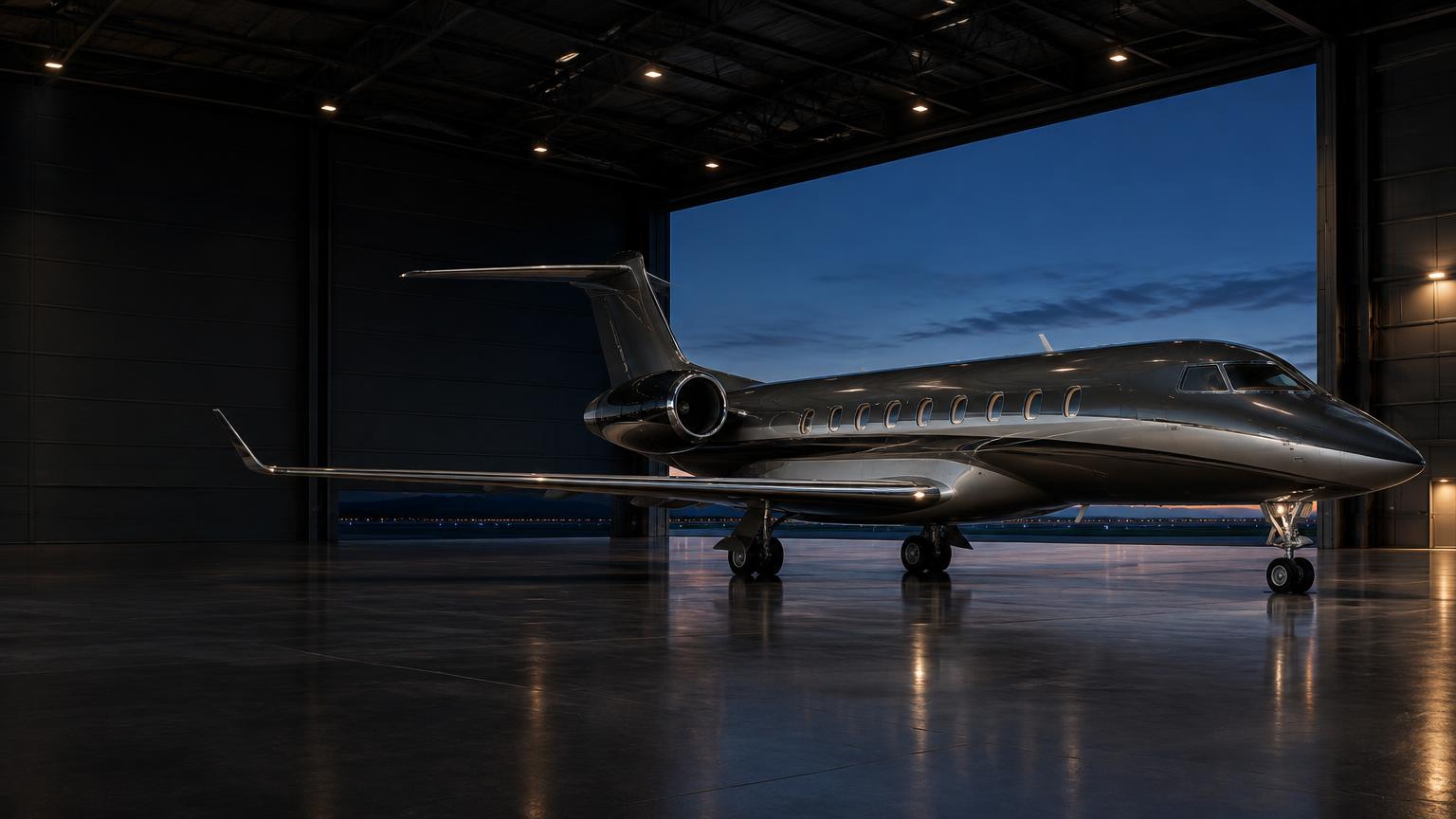
The last of the smaller Falcon trijets
The original Falcon 50 first flew on 7 November 1976 and became the Falcon family’s first transoceanic aircraft. The 50EX followed: it first flew on 10 April 1996, was certified in France and the US in November and December 1996, and was delivered from January 1997 until production ended in early 2008 at 100 units. In certification terms it is not a new model. EASA’s type certificate describes the name as a commercial designation for Mystère-Falcon 50 aircraft built with six major modifications on the assembly line, among them three TFE731-40 engines.
Business Air News counts 99 Falcon 50EX in the world fleet, 18 of them available for charter, and 287 active Falcon 50-family aircraft, 61 available for charter. A small, ageing fleet, then, but not a rare one on charter quotes.
Range: 3,223 nm with every seat filled
Duncan Aviation’s October 2026 summary gives the 50EX 3,223 nm NBAA IFR range with all seats full and 3,388 nm as a ferry flight, against 3,057 nm seats-full for the earlier Falcon 50. Its normal cruise speed is 459 knots, against 431 for the Falcon 50.
On great-circle distances, by my arithmetic and before winds: Farnborough to Teterboro is about 2,990 nm and Paris Le Bourget to Teterboro about 3,150 nm, both inside the seats-full figure, but not by much. Geneva to Teterboro, about 3,350 nm, is beyond it. Paris to Dubai Al Maktoum, about 2,840 nm, and Teterboro to Van Nuys, about 2,130 nm, are comfortable on paper, before any rerouting around closed airspace. Eastbound across the North Atlantic, with a full cabin, a non-stop is realistic on many days; westbound in winter I would plan for a possible fuel stop and only promise a non-stop when the operator’s flight plan supports it. Why I treat published range this way is set out in realistic range and reserve margins.
Payload: where the 50EX still surprises
The figure that keeps the 50EX on my shortlist is payload with full tanks. Duncan lists 2,130 lb for the Falcon 50EX, against 1,907 lb for the Challenger 350, 1,280 lb for the Falcon 50 and 650 lb for the Gulfstream G200. By my arithmetic, that is about 220 lb more than a Challenger 350 can carry with full fuel, which can mean one more passenger with bags on a long sector.
The cabin is the trade-off. Duncan gives it as 23.5 ft long and 6.1 ft wide, with 569 cubic feet of volume, 115 cubic feet of baggage and nine typical seats. The Challenger 350, in the same summary, is about a foot wider at 7.17 ft. In practice that is a narrower aisle and a cabin that feels more like a well-kept study than a lounge. I describe the wider aircraft in my Challenger 350 guide, and the class differences in midsize versus super-midsize jets.
Three engines: what they do and do not buy you
A third engine is real redundancy, and many passengers find it reassuring over water. It does not, however, change the rules for a US charter operator. Under 14 CFR 135.364, no certificate holder may plan a route more than 180 minutes from an adequate airport outside the continental United States without ETOPS approval; the only exemption is for all-cargo aeroplanes with more than two engines. A passenger-carrying trijet on charter is held to the same 180-minute line as a twin.
Weight matters for one practical reason in Europe. EASA certifies the 50EX at a maximum take-off weight of 18,008 kg (39,700 lb), or 18,500 kg (40,785 lb) with Service Bulletin F50-161. Both are below the 20-tonne line that today triggers the UK’s higher rate of Air Passenger Duty. That line is about to move, as the next section explains.
What it costs to run and to charter
Duncan estimates the 50EX’s total variable cost at $6,315 per hour, with fuel at $5.69 a gallon and major inspections excluded, against $5,421 for the Challenger 350 in the same summary. By my arithmetic the older trijet runs about 16% dearer per flight hour. Its average fuel burn is 307 gallons an hour, against 280 for the Challenger 350.
Jet Supply’s revised Q4 2026 index does not name the Falcon 50EX. Its super-midsize band, led by the Challenger 350, Praetor 600 and G280, runs €6,000 to €9,000 per hour in the air, before positioning, fees and taxes. I treat the 50EX as a super-midsize-band aircraft and ask the operator which band its quote is built on.
For UK departures the duty line is worth knowing. Today the higher rate applies to planes of 20 tonnes or more equipped to carry fewer than 19 passengers, so a 50EX pays the standard rate where the seat pitch exceeds 40 inches: £32 per passenger to a band A destination in 2026–27, against £142 at the higher rate. From 1 April 2027 the higher rate extends to all aircraft of 5.7 tonnes or more used as a private or business jet, at £146.63 for band A. By my arithmetic, eight passengers to a European destination would pay £256 today and about £1,173 from April 2027.
Buying one: cheap to enter, expensive to neglect
Duncan’s Vref-based range for the 50EX is $2.824m to $5.299m, indicative rather than an appraisal; the Challenger 350’s range in the same summary starts at $15.233m. Guardian Jet’s market page shows 18 aircraft for sale, 18% of the fleet, asking $2.75m to $5.95m, with model years from 1997 to 2004. More used values by model are in my note on used private jet prices.
The market is soft. Holstein Aviation’s latest snapshot reports inventory up 36% on a year ago, average asking prices down 15% in the quarter and about one sale a month, with roughly 23 months of inventory. GlobalAir.com data reported by AviNews on 11 November show that Gulfstream G200 and Falcon 50-series jets accounted for six of the 11 super-midsize listings added, with 56 listed and a median of about 210 days on market.
Holstein notes that aircraft with ProLine 21 avionics upgrades and recent C inspections sell at a premium, because of parts availability and corrosion, and earlier snapshots add landing-gear overhaul backlogs. Duncan lists the factory avionics as Collins Pro Line 4. I read inspection status, corrosion findings, engine programme enrolment and avionics before the asking price; a cheap 50EX with a major inspection due is rarely the cheap one.
When I choose it, and when I do not
I put a Falcon 50EX on a charter shortlist for six to nine passengers with real luggage on sectors of three to six hours: London or Paris to the Gulf, a European city pair with a family and their bags, or an eastbound Atlantic crossing. I look elsewhere when the cabin width matters on a long sector, when connectivity is essential and the aircraft has not been upgraded, or when a westbound winter crossing must be non-stop. The Falcon 2000LXS is the wider, newer Falcon answer at a higher price.
Charter enquiries I take are fulfilled through Limitless Sky. If a 50EX appears on your quote, ask for the tail number, the year of build, the cabin layout and a fuel plan at your real passenger load, and compare it with the aircraft either side of it. Limitless Sky’s charter page is the place to start a request.
Frequently asked questions
How far can a Dassault Falcon 50EX fly? — Duncan Aviation gives 3,223 nm NBAA IFR range with all seats full and 3,388 nm as a ferry flight. Farnborough or Paris to Teterboro is inside the seats-full figure on paper; only the operator’s flight plan on the day confirms a non-stop.
How many passengers does a Falcon 50EX carry? — Nine is the typical layout in Duncan’s summary. With full tanks it can carry 2,130 lb of payload, more than a Challenger 350’s 1,907 lb.
What is the difference between the Falcon 50 and the Falcon 50EX? — The 50EX, built from 1997 to 2008, has TFE731-40 engines, a faster normal cruise (459 against 431 knots) and longer seats-full range (3,223 against 3,057 nm). EASA treats it as a commercial designation of the Mystère-Falcon 50, not a separate model.
How much does a used Falcon 50EX cost? — Duncan’s indicative range is $2.824m to $5.299m. Guardian Jet showed asking prices from $2.75m to $5.95m in November 2026. Inspection status and avionics move the price more than the year.
Is the Falcon 50EX still in production? — No. Production ended in early 2008 after 100 aircraft; Business Air News counts 99 in the world fleet.
Planning a specific journey? Live charter enquiries are handled by Limitless Sky, where the operator, aircraft and terms for your itinerary can be discussed.
Sources & editorial notes
Written by Dr. Christoph Lymbersky as an authored perspective drawing on the public sources below. Sources reviewed 15 November 2026.
General guidance, not individual legal, tax or investment advice. Figures come from the sources below unless marked as my own calculation. Client examples are anonymized.
- Duncan Aviation — Business Jet Model/Market Summary ↗
Vref value ranges and variable cost per hour by model. Values are indicative, not appraisals.
- Business Air News — Handbook: Dassault Falcon 50 (incl. Falcon 50EX), accessed 15 November 2026 ↗
Falcon 50 first flight 7 November 1976, Falcon family’s first transoceanic aircraft; Falcon 50EX launched April 1995, first flight 10 April 1996, French and US certification November and December 1996, first delivery January 1997, production ceased early 2008 at 100 units; world fleet 99 Falcon 50EX (18 available for charter); 287 active Falcon 50-family aircraft (61 available for charter).
- EASA — Type-Certificate Data Sheet EASA.A.062, Mystère-Falcon 50 / Mystère-Falcon 900 / Falcon 900EX (Issue 10, 15 September 2026) ↗
Falcon 50EX is a commercial designation for Mystère-Falcon 50 aircraft with six major modifications embodied on the assembly line, not a new model; Falcon 50EX maximum take-off weight 18,008 kg (39,700 lb), or 18,500 kg (40,785 lb) with Service Bulletin F50-161; maximum landing weight 16,200 kg.
- eCFR — 14 CFR 135.364, Maximum flying time outside the United States ↗
No certificate holder may operate an airplane, other than an all-cargo airplane with more than two engines, on a planned route more than 180 minutes (one-engine-inoperative cruise speed, still air) from an Adequate Airport outside the continental United States unless approved for ETOPS under Appendix G.
- Jet Supply — European Private Jet Charter Price Index Q4 2026, revised 1 November 2026 ↗
Revised bands per hour in the air for the whole aircraft, crew and fuel included, positioning, airport and handling fees and taxes excluded: midsize jet (Learjet 60XR, Hawker 900XP) €5,300–€7,000; super midsize jet (Challenger 350, Praetor 600, G280) €6,000–€9,000, mid-band €7,500; super light jet €4,000–€6,000; London–Mykonos (3h 30m, super midsize) flight only from €21,000, typical all-in €37,000–€52,000 one way; not comparable with the Q3 2026 edition.
- HMRC — Rates and allowances for Air Passenger Duty (updated 1 April 2026) ↗
Rates from 1 April 2026 (band A: reduced £15, standard £32, higher £142) and from 1 April 2027 (band A: standard £33.04, higher £146.63); standard rate where seat pitch exceeds 40 inches; higher rate currently for aircraft of 20 tonnes or more equipped to carry fewer than 19 passengers.
- HMRC — Air Passenger Duty: extension of the higher rate (13 July 2026) ↗
Policy paper: from 1 April 2027 the higher APD rate applies to all aircraft of 5.7 tonnes or more used as a private or business jet; Exchequer impact and scope.
- Holstein Aviation — Falcon 50EX market snapshot (library page, accessed 15 November 2026) ↗
Latest snapshot: inventory up 36% year on year; average asking price down 15% in the quarter; about one sale a month, 12 retail sales in 12 months (1997–2004 vintages); about 23 months of inventory; aircraft with ProLine 21 upgrades and recent C inspections sell at a premium because of parts availability and corrosion; earlier 2026 snapshots also cite landing-gear overhaul backlogs. Holstein model overview: normal cruise 460 kt, 2 + 9 seats, max range 3,400 nm.
- Guardian Jet — Dassault Falcon 50EX brochure and market data (accessed 15 November 2026) ↗
Fleet size 100 (model years 1997–2007); current market: 18 for sale (18% of fleet), asking $2.75m–$5.95m, model years 1997–2004; engines three Honeywell TFE731-40; typical avionics ProLine 4; range 3,230 nm.
- AviNews (Avi-Go) — Large-cabin jet sales fall 38% from last fall as listings rise to 188, GlobalAir.com data show (11 November 2026) ↗
GlobalAir.com marketplace data as of 2 November 2026: super-midsize supply rose to 10.8 months from 9.4; legacy G200 and Falcon 50-series jets accounted for 6 of the 11 added super-midsize listings and number 56 listings with a median of about 210 days on market.
The illustrations are generated aviation imagery, not evidence of a specific aircraft or operator.
For a live itinerary, see the charter advisory guide or start a private enquiry.